Showing posts with label Books. Show all posts

Tuesday, August 16, 2011

A Novel This Full of Drunken, Gambling, Womanizing Debauchery Isn't Usually Called Literary


On the occasion of Charles Bukowski's birthday, a reposting:


CHARLES BUKOWSKI'S "POST OFFICE"


They don't do it anymore but not too many years back the big Indigo bookstore at Bay and Bloor in Toronto (a store I now know well) kept certain fiction titles, certain authors' novels, behind the Special Orders desk. Authors like William S. Burroughs, Haruki Murakami and Charles Bukowski were kept back there. You had to ask the staff to even look at them. Why? Because these were the titles most often stolen off the bookshelves. This should be reason enough for readers of a certain age and/or contrarian bent to be interested. It sure worked for a twenty year-old me. Still does on some level.


Charles Bukowski was a drunk. He was a gambler. He was a womanizer, but only when he got famous enough that he could get those women to womanize with. Think the dirtiest dive of a hole-in-the-wall bar you've ever seen. That's the kind of place you'd have found Charles Bukowski in and chances are you wouldn't have liked the man, and he would have been a right prick to you, and me too.

But then Hemingway was said to be the grand egocentric, anti-semitic prick of them all and I bloody love three of his novels to a reverent degree.

Bukowski too, he was one who could tranform himself on paper. Produce a little magic. Give a little something he probably couldn't be quite as generous with in his lived life.

He got famous as a poet, as a poet who would go to reading drunk and drink while he read. He got so famous for this that audience members liked to plow him with alcohol, get him truly wasted to up the perfomitivity of his reading.

But that's not why they came to hear his stuff.


There are books about wizards and there are books about vampires. Then there are the New Yorker friendly type of books that involve adultery and a certain middle-class unhappiness. There are books we call chick lit, there are the books that Ken Follett writes where good is good and bad is evil and it's all epic and historic and very well researched. Oh there are so many kinds of books but nowhere I can think of does Charles Bukowski squarely fit, least of all in any category that would have ever won him a Booker Prize. Salman Rushdie would not have been his best mate, believe me.

The closest to Bukowski I can think of would be a William S. Burroughs type or our current dark and dirty writer, Chuck Palaniuk, though I have to admit I've yet to read him.

Bukowski is writing the truths he knows and he does it beautifully. He writes about a class of people so low they can't, as I recently heard it put, be called blue collar since they have no collars to speak of. These are the people of the sketchiest parts of L.A., where Buk, as his fans and friends referrred to the writer, grew up. These are the drunks and the gamblers. These are the sorry souls with the crappy wives and the lousy cars. They are the lowlifes of a society that prizes getting ahead in your career by making more cash, where success is measured by the size of your house.

Bukowski is speaking for a very different group of people, a people far from what many of us know, and yet a middle-class Jewish boy from Canada can still relate. He can still read and relish and eat up so much of the truths he feels are his in Bukowski's work.

With Post Office, Bukowski's first novel, that I so enjoyed on re-reading (in a single day!) this past winter break (holed up in a bachelor apartment on 42nd avenue with my wife, no TV, no internet, no toaster oven, just a bad bad flu and a good good book) we get the story of Henry Chinaski, a not remotely disguised Bukowkian alter-ego, and his various crap jobs from the US Postal Service. What makes the story is the humor, the honesty, the drudgery, the sex, the drinking, the sex, the humor and the sex. Did I mention the sex? Bukowski gets down and dirty about the world, how he sees it, how it is. Morals are thrown out the window and the flank, as he calls it, of a woman's leg is in detail described. So too are the real crappy moments in our lives - our jobs! - and the terrible mundane way they can be, or how slavishly they can get us to work against a clock and how we sweat and puke to just keep up. And how hard that is.

He writes best about being screwed as the little guy, but then finding his little dirty ways to screw back, and I mean that every which way you imagined. And in every way the screwing is satisfying to read about, titilating, bloody revenge satisfying or just eye-ball popping wtf intriguing. Bukowski was destined to self-destruct but he did it with flare and he managed to laugh about it and he managed to even get some pretty poetic pathos out of it. But the crap jobs and then getting fired or quitting and then living off what he could win at the track, and then the women, oh the women. The fucking and the drinking, the flirting and the fighting. All of it full-tile, no holds barred. That's how he lived. That's how he wrote. There is no bullshit. There certainly aren't any aphorisms to be learned.

By now you see that  Post Office is not for everyone. I have yet to encounter a book club that would embrace it or anything else by Bukowski. If, however, you've ever wanted to steal a book, or stole one, or just give a grown-up finger to the Man, Buk (here reading his poem Bluebird) is for you.


[Originally published February 2011]

Friday, July 15, 2011

Desert Island Novel to Read and Read Again # 2: J.D. Salinger's "The Catcher in the Rye" - Part I


HAPPY 60TH "THE CATCHER IN THE RYE"

[Originally published December 25, 2008]
[Click Haruki Murakami's "Norwegian Wood" for Desert Island Book to read and read and read #1]


The Catcher in the Rye made me feel less lonely at a time (15 years of age) when all I touched, as Salinger put it in one of his Nine Stories, seemed to turn to complete loneliness. It's the reason I started writing. It was the first work of fiction to break my heart as it healed my soul. And God Bless, because this Jew interested in Buddhism had found his truest religion.

THE INFATUATION
For the longest time I tried to keep my obsession with Salinger's only full-length novel to myself. Oh I would tell people I loved The Catcher in the Rye, or that Salinger was my favourite writer, but I honestly tried to not go further with it than that, to put a lid on it. I'd never have admitted that it wooed me to falling in love with New York forever, never mind the number of times I have read it, not including random flips for favourite passages. Or the fact that I somehow managed to write my Masters thesis on it, when my Masters was supposed to be in applied linguistics and what the hell did that have to do with English literature.

That first 15 year-old time was not for school, which may be the key to everything. I read it fast, just a few days and I was not (and am not) a fast reader. Holden Caufield's breezy first-person narration was so much like conversation you just zipped through. The book's famous opening:

If you really want to hear about it, the first thing you'll probably want to know is where I was born, and what my lousy childhood was like, and how my parents were occupied and all before they had me, and all that David Copperfield kind of crap, but I don't feel like going into it, if you want to know the truth. 

The book read so fast, so easy, so true I was convinced it was pure autobiography. Not even, cause autobiography still implies some semblance of putting together, of structure, work, effort. The Catcher in the Rye, to me, that first read, and the way it stayed in my mind long after (cause I wouldn't re-read it for at least five years, afraid of tainting that first read experience) was, I was sure, simply, if beautifully, Salinger writing his thoughts and experiences in a journal. The book was a particularly fascinating series of diary scribblings. This to me was profound because it felt like the true heart of a person, which has always captured me more than the mind, and the gimmicky tricks it can play (much as a twist ending is always exciting it's not the kind of thing that'll make it to my island).


WHAT LIES BEYOND POP IN MUSIC, AND HARRY POTTER IN FICTION

Digging through my big sister's records back when I was 12 (and big sisters had records to dig through) I discovered Pink Floyd, the song 'Comfortably Numb' in particular. It was a revelation - my first listen of something other than the bubble gum pop that really got me. I mean REALLY. This wasn't just music, this wasn't just wanting to hear Paula Adbul's latest hit for the umpteenth time cause it made you feel chipper or helped you not think about things; this was different, this was soul food, this was necessary - this made me think about things; shit, this was gonna bring me closer to God. Or, at the very least, help me get through grade seven, which as we all know is a crap age.

The Catcher in the Rye was not a story, not in the Narnia, Hardy Boys sense. It spoke the truth about things that I was living, that I was struggling with. The "Hardy Boys" was like Coca-cola, a treat I could have on weekends. The Catcher in the Rye, on the other hand, was water. I needed it.

HIS TRUTH
Holden spoke of things I'd never heard anyone say. He spoke the thoughts I had in my head. About the phoniness of people. About dishonesty and how hard life can be. And somehow, in travelling with him as he sneaks out one night to leave Pencey Prep forever (the school he is about to be kicked out of anyway) and trains it to New York, I felt less lonely. This kid was searching for something as I was, as so many kids do as they hit that age when they start to become aware of the world. And what I love is that the novel is as much about grand philosophies, on death, and what it means to live, and about losing the innocence of childhood, as it is about the simpler (or maybe more complicated) things. Like girls.

I was half in love with her by the time we sat down. That's the thing about girls. Every time they do something pretty, even if they're not much to look at, or even if they're sort of stupid, you fall half in love with them, and then you never know where the hell you are. Girls. Jesus Christ. They can drive you crazy. They really can.

Great art is about connection. At 15 I was sure I was Holden. At 23 it was Salinger I wanted to emulate most. The real point though is about what makes a book great, what makes something worth re-visiting. Holden, of course, says it better than I can:

What really knocks me out is a book, when you're all done reading it, you wished the author that wrote it was a terrific friend of yours and you could call him up on the phone whenever you felt like it.

This is the end of Part I.
[Click Salinger's The Catcher in the Rye Part II  for part II.]
[For Desert Island Book to read and read again # 3 click Arundhati Roy's The God of Small Things]


Tuesday, April 19, 2011

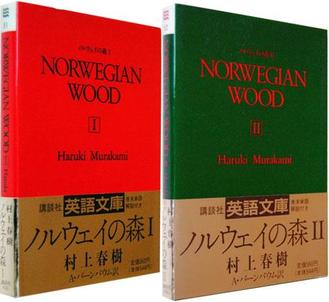
Desert Island Novel to Read and Read and Read Again #1: Haruki Murakami's "Norwegian Wood"


[Originally published November 28, 2008]


I once had a girl
Or should I say, she once had me


I was living in Osaka, Japan, teaching at a conversation school in a place called Takarazuka the first time I read "Norwegian Wood." When I reached the last page of the novel, after reading its pitch-perfect last line, due to an utter unwillingness, a near inability, to leave the beautiful world Murakami had created, I proceeded to immediately flip back to the first page and start all over again. That was seven years ago. I've read it again since. More than once. I've also gone on to read and buy every book of Murkakami's translated into English, including his short story collections, and non-fiction.

Why? Because "Norwegian Wood" hit a place in my soul, it became a mate to my soul, a heart to beat along next to mine.

The Beatles song Murakami's 1987 novel is named after is on surface listen a pretty two minute ditty. A pretty, but sad, thing. The tone of Murakami's novel has something similar gently pulling the reader through. It is also equally deceptive to the song in how simple it seems, how easy it reads. Yet, beneath a book that reads like almost pure autobiography, and a song that listens like effortless melody, lie layered artful structure, and things thematically heavier than meet the eye.

The Beatles' song that is so melodically sweet ends with a man taking revenge on a girl who would not sleep with him, by burning down the furniture in her room.

Murakami's narrator does no such thing. But his book too juxtaposes a gentle tone with themes of longing, of loss and of what can and will never be.


To be intentionally vague (no plot spoilage here) and very brief, "Norwegian Wood," set in the Tokyo of the 1960s, is a love story. Basically it is a sad story. Most all the love in the book is of the unrequited variety, and there is more than one suicide. The book has much to lend itself to feeling blue, like Miles Davis on his muted trumpet. But for every lonely moment, you get a scene with a character like Reiko, a friend like Reiko, a woman who should be tragic considering her history but who, by the time we meet her in a sort of sanatorium for sad or screwed up people, turns out to be that rock solid salt-of-the-earth type who seems like the mentally healthiest person in the book. Better still, though no longer the piano virtuoso she once was, she plays a mean guitar, Beatles song included.

The magic of Murakami's "Norwegian Wood," is that a book so focused on sad subject manner manages to have what all books need to be great - a sense of adventure. Not, of course, in the children's literature sense of the word, but in the 'you've gone off to another place' sense.

... the bus plunged into a chilling cedar forest. The trees might have been old growth the way they towered over the road, blocking out the sun and covering everything in gloomy shadows. The breeze flowing into the bus's open windows turned suddenly cold, its dampness sharp against the skin. The valley road hugged the river bank, continuing so long through the trees it began to seem as if the whole world had been buried for ever in cedar forest - at which point the forest ended, and we came to an open basin surrounded by mountain peaks. Broad, green farmland spread out in all directions, and the river by the road looked bright and clear. A single thread of white smoke rose in the distance...

Best of all is the poetry is in the book's balance, as alongside depression and suicide, you also get a character like Midori - one of my favourite in all modern literature.

At 5:30 Midori said she had to go home and make dinner. I said I would take a bus back to my dorm, and saw her as far as the station.
"Know what I want to do now?" Midori asked me as she was leaving.
"I have absolutely no idea what you could be thinking," I said.
"I want you and me to be captured by pirates. Then they strip us and press us together face to face all naked and wind these ropes around us."
"Why would they do a thing like that?"
"Perverted pirates," she said.
"You're the perverted one," I said."


And really, what else do you need to help you cope with death, and the kind of love that will never be, but perverted pirates?

[Click J.D. Salinger's The Catcher in the Rye for Desert Island Book to read and read and read again # 2]


Tuesday, April 12, 2011

The Elegance of Intelligence in Paris: A Book Recommendation

[Originally published December 26, 2009]

In my romanticized version of Europe, after I've eaten ravioli in Roma, and sipped cappuccinos at a stand-up cafe, then I will stroll along the Seine and stop at booksellers with used treasures they sell along the river. In my romanticized version of Europe, the French and the Germans and the Albanians, they all drink good wine and smoke Gauloises at will. They eat thin slices of excellent cheese and talk about interesting things and deep things and not what they watched last night on TV. They talk about politics and paintings, they discuss books and don't care what Oprah thinks. The men read fiction and care about it. The women dress well but are also smart as hell. Together the men and the women, before they go off to have tantric sex on old-fashioned beds, they have long slow dinners at long wooden tables, or perhaps they are small round tables at an outdoor cafe on a cobblestone walkway, some Van Goghian starlight to brighten the evening, to sparkle off their bread knives.

This place I imagine is not real, I know. Oprah is shown around the world. Michael Bay films are global monsters and we stopped lighting the night with stars a long long time ago.

But then I read Muriel Barbery's "The Elegance of the Hedgehog" and all the intelligence and philosophy and the wit and the hope and pathos of the European, of the French, becomes real again. I haven't flown through a work of fiction like this in ages. Fact is, I keep putting the books I'm reading down (Hilary Mantel's Booker Prize winning "Wolf Hall" included). Barbery isn't afraid to discuss Marx and issues of class that continue today, she philosophizes on death and the meaning of life, but then she also discusses her love of Ridley Scott sci-fi movies and she quotes Eminem.

Yet for all its brainy seduction, the book is no lecture, the story no bore.

For those who require a book description, here, c/o Amazon, it is (for those who don't, skip this next paragraph):

We are in the center of Paris, in an elegant apartment building inhabited by bourgeois families. Renée, the concierge, is witness to the lavish but vacuous lives of her numerous employers. Outwardly she conforms to every stereotype of the concierge: fat, cantankerous, addicted to television. Yet, unbeknownst to her employers, Renée is a cultured autodidact who adores art, philosophy, music, and Japanese culture. With humor and intelligence she scrutinizes the lives of the building's tenants, who, for their part, are barely aware of her existence. Then there's Paloma, a twelve-year-old genius. She is the daughter of a tedious parliamentarian, a talented and startlingly lucid child who has decided to end her life on the sixteenth of June, her thirteenth birthday.

How many times did I stop at my local Indigo bookstore to look at the beautiful blue of the cover and the sheer perfection of that title: The Elegance of the Hedgehog. But it takes so much more to buy book, to read book, to trust all those hours to turn all those pages to force all those neurons. So I must thank my dear friend, poet, writer, and philosopher, Sana, for the suggestion. She told me I had to. And we all have friends like these. When they tell you you have to - you have to.

So I did. And now I recommend it to you.

Follow me on twitter; you'll love it; I swear.

Tuesday, April 5, 2011

In the Telling

None too many can tell a tale like a Jack London or an Ernest Hemingway
And this one, it won't be easy
I can say that straight
It'll be told simple enough though
The language mostly plain
But in the telling a kind of beauty
Of what men must do
Men in nature
Men against the elements and worse still against each other
And themselves
The old story, the struggle to survive
Campin out there in the wilds
A fire to keep the lions from getting at your horse
Or so the story goes
But so too the way the moon looks reflected off a river
Just to stop and notice that
Amidst the harsh world God has wrought
That's what this tale'll show
That's what it'll do
The writer calls himself McCarthy
The book's "The Crossing"
Part of his Border Trilogy
This the second in said threesome
And I'm recommendin her to you

Thursday, March 24, 2011

Desert Island Novel to Read and Read and Read Again # 6: Ernest Hemingway's "Fiesta: The Sun Also Rises"

In honour of Hemingway Week at ye old PBIHT.. 
[Originally published here on August 13, 2010]

For Desert Island book to read and read and read again #5 click Steinbeck's "East of Eden"


Fiesta or The Sun Also Rises is perhaps more heart breaker than soul healer; it's a dark world Hemingway paints, but it's also enormously exciting, adventurous, honest and so beautifully written. Sometimes the most heart breaking of art works heal our soul by the beauty of their construction. The content may be dark, but the architecture is the part that uplifts. When it comes to his fellow man Hemingway was rather the cynic. But in nature or when it came to women, he was a romantic in the extreme. 


No Old Man, Barely any Sea
I was so intimidated by Hemingway's very name, as I think we all are by the big classic names in literature that, as I wrote about in my last Novel to Break Your Heart Even As It Heals Your Soul piece on For Whom the Bell Tolls, that first encounter with the author on my friend's toilet was a genuine relief. That - on my friend's toilet - is where I discovered Fiesta or The Sun Also Rises. It was my first Hemingway and for that I think I'm lucky. Too many were forced, or at least misled to choose, to read The Old Man and the Sea. This is a tragedy cause it would have you believe that Hemingway is always boring, long-winded, portentous and pretentious. He's not. The Old Man and the Sea, as the name so aptly describes, has nothing in it but an old man and a great big sea. There are no women folk. There is no love story, and as I've said here before, that's the big secret about Hemingway. The big lug was a full-blown romantic at heart.

This was Brett that I had felt like crying about. Then I thought of her walking up the street and stepping into the car, as I had last seen her, and of course in a little while I felt like hell again. It is awfully easy to be hard-boiled about everything in the daytime, but at night is another thing. 

His earlier novels are far more interesting for this - they aren't just about man and nature. In fact, in the beginning it was far more human drama, far less about nature. I'd argue it was actually Hemingway's ability to break up his long passages of human drama with scenes of people-less nature that created a kind of perfect balance in the work (a kind of balance sorely lacking in the The Old Man book, where I'd have killed for a little human-on-human drama).

Rather the Book Than the Man
There are so many things about Hemingway I don't like, but most have more to do with the man than the writing, though of course the man is in the writing all over the place. What's not to like? Oh I don't know, the antisemitism, the utter male chauvinism and worst of all the self-aggrandizing macho bullshit. And Hemingway can, at times, be totally full of it, like a bad Marlboro commercial's version of the caricature of what a man "should be." For guys that buy into beer commercial definitions of gender. 
 
Fiesta is great cause it has far less of the macho. There is no old man, there is no fishing, there is little to no sea. It's not a book about war either. Now, yes, there is a whole slew of information about bull fighting, but it's quite interesting and it's not overlong, not a tenth of the hundreds of pages of French history you get in, say, Hugo's Les Miserables. Also, it's set amongst a fiesta, a truly Spanish celebration of seven days and nights of madness and drinking and unhappiness and elation and the way people are when there are no consequences. 

Plotless Wonder
My all time-favourite books, of which I count Fiesta or The Sun Also Rises one (the former was Hemingway's original title, used in Britain; in North America, however, the book was renamed The Sun Also Rises) manage to not feel like they have any plot. This is the most dangerous kind of story writing because usually it is bound to fail on its ass. Though you've probably never before heard Fiesta compared with Murakami's Norwegian Wood or with The Catcher in the Rye, I think they share something structurally. None of these books follows the kind of obvious plot line that is common to more traditional modes of novel writing.

These are my favourite kinds of books. They aren't epic in scope. They don't involve casts of thousands. And no codes need be broken, no vampires spoken. The mystery - and genius - of them is that they read like life and yet of course are so much bigger than that. This is the danger with Hemingway, I'll acknowledge. Without a wee bit of patience, The Sun Also Rises can read almost mundane at times, the way a simple day is described. To me though, the utter beauty of a "simple" Hemingway description ... let's just say he might be the most evocative writer of a scene I've ever read. Certainly in terms of capturing the beauty of nature; few writers I've ever read better put a picture in my mind (and teach me how few adjectives and big words are necessary to get the job done right).

In the morning it was raining. A fog had come over the mountains from the sea. You could not see the tops of the mountains. The plateau was dull and gloomy, and the shapes of the trees and the houses were changed. I walked out beyond the town to look at the weather. The bad weather was coming over the mountains from the sea. 

The flags in the square hung wet from the white poles and the banners were wet and hung damp against the front of the houses, and in between the steady drizzle the rain came down and drove every one under arcades and made pools of water in the square, and the streets wet and dark and deserted ...

The utter simplicity of the language, the near child-like simplicity of it (the repetition of the words, for example) all the more beguiles the reader when considering how much misdirection there is in this book. You are already some thirty pages in before you've even been given a hint of what the story is truly concerned with. (It's not bull fighting).

The Spanish fiesta itself, of the binge drinking and bull running, does not begin until halfway through the novel, and much of the book's contents, be they in Spain or France, are about the underbelly of human relationships. So much of this story is of people eating good food and drinking copious amounts of wine (no writer makes me hungrier or thirstier), and in the midst of all this it is about how people can be so jealous and cruel, of love and hate, of friendship and misery.

Roger Ebert, the film critic, said the following of film, but it of course goes doubly for literature as well: The greatest works are always something of a mystery - that's what keeps us coming back.

Tuesday, March 22, 2011

Is Sushi a Moveable Feast? A Weak Imitation of Master Hemingway

In honour of Hemingway Week at ye old PBIHT.. 
[Originally published here on March 19, 2010]

There was a warm, friendly atmosphere in the sushi shop. I sat at the bar of the restaurant, sipped the green tea and pulled my new hard-covered book from my bag. I ordered my usual for a Japanese restaurant so far from Japan, where unless you have the money to blow, you won't get fish good enough for straight sushi. I ordered the rolls that have the shrimp tempura and green vegetables inside and that are topped, each one, with a big generous slab of salmon, an orange not quite the lovely bright you find in Kansai, but still with those white V-shaped stripes that go down the length of the fish. The salmon slithered smooth and sweet down the throat when you ate it. The crunch of the tempura and wedge of cucumber balanced the softness of the fish and the ripe avocado, and then to wash it down with the cold of the Japanese beer I had ordered to go with it. The fresh crispness of the lager complimenting the sweetness of the fish.

It was good to be alone in the restaurant like that, sitting, the only one, at the counter, but comfortable there, absorbed as I was in the flavours, and the slow chopstick way I'd learned from a friend to eat sushi, putting wooden utensils down after eating each piece, making the meal last, allowing the belly to fill. And all the while reading sensous pages far better written than this and so strongly styled, so uniquely written. I felt inspired to rush home (I didn't rush - that's a lie; the weather too spring gorgeous to rush, the night too clear, a sliver of moon high in the clean air) and write about my experience in the style of the book I was reading. Or at least, a lazy approximation of that style, of Hemingway's style, in particular from his great collection of memoirs called, "A Moveable Feast." Cause what I'm really trying to do is recommend this remarkable literary remembrance to you.

Friday, December 3, 2010

A Book to Read and Probably Reread, Probably Because ....

Wading in Plotless Wonder: Percy Walker's The Moviegoer

There are generally 2 types of fiction readers: Those that want a good solid story in the plot sense, and those that are looking for something else.

The story lovers are often into epic tales. Harry Potter's stories would fit here, but so would most of Steinbeck's books (certainly the big ones). Those looking elsewhere, on the other hand, are suspicious of plot. They aren't sold on stories that wrap up so neatly at the end.

I, for one, like both types. Then again I'm a Gemini.  So I'm fucked.

The story lover in me loves East of Eden, The Fountainhead, A Fine Balance.

The other in me loves The God of Small Things, Haruki Murakami and The Catcher in the Rye.

All this to recommend Percy Walker's The Moviegoer. But only to that other kind of reader. Cause I'm not sure I have the foggiest notion what the book's about, and I only just finished reading it a couple weeks ago. And while not fully comprehending where you're following the protagonist or why can be mildly irritating, it's also what makes the book rather mystifying and pretty uniquely amazing.

Roger Ebert, the reviewer, once said that Citizen Kane is his all-time favourite film cause no matter how many times you watch it you can never quite solve the mystery of the film. I have a strong feeling I'll be rereading The Moviegoer in the near future, cause I have no idea, and the plot wasn't clear or with much purpose, and yet the meandering nature of the story, and the utterly lovely paragraphs of description that Walker gives, mmm... yeah, I could wade in those waters again.

Like nothing I've ever read.

Oh, and it won the National Book Award the year after it was published - 1962.
So I'm not totally alone on this.

Wednesday, October 20, 2010

Desert Island Novel to Read and Read and Read Again #7 - Haruki Murakami's "Dance Dance Dance" (or "Dansu Dansu Dansu" in Japanese)

[For Desert Island Books to Read and read and read again # 6 click Ernest Hemingway's Fiesta: The Sun Also Rises]


PART I 


Surprise Ain't the Only Thing That Translates
At the New Yorker Festival talk Haruki Murakami gave a couple years back, describing the effort of writing books, I swear Japan's now most famous author must have told the audience that writing was "fun!" at least five times. And when I say "fun!" I  mean that he said it (I know, I was there) with a near shoulder-shrug, high-pitched ease, like the way your ten year-old nephew would nearly indifferently describe his gloriously perfect day at Canada's Wonderland. Murakami wasn't being obnoxious; he wasn't saying writing a novel like Dance Dance Dance was easy; he was just trying to say that he enjoyed the process as much as he did. Still, you're sitting there listening to your favourite writer, taking furious notes like the wonder-student you never were, hoping to learn a few things, and there he is shoulder-shrug, high-pitched saying, "It's fun!"

You think I wasn't jealous?

There's an expression popular amongst those of us with writerly aspirations: No surprise for the writer, no surprise for the reader. If you've plotted and planned out every detail of your book you'll never truly throw your reader for a loop. If, however, on page 342, as you're finishing your first draft, you realize that - holy crap! - your heroine is going to commit suicide, chances are you'll be instilling a rather holy crap feeling in your reader as well. They never saw it coming and how could they? You didn't either.

This of course doesn't only apply to surprises. Joy also translates and that fun Murakami feels in the crafting of his stories is evident throughout his extensive body of work. There is, as I've said on this blog before, a lightness to his stories no matter the subject matter. I don't mean they're all airy-fairy popcorn (for airy-fairy popcorn see Banana Yoshimoto). They aren't. But even when death is a theme it manages not to veer into the hopeless or nihilistic. His stories can get sad; they just never seem hopeless. There is an acceptance there, an always calm acceptance of what life is, of what it will deal. In turn, there is always a light behind, beyond or just the other side of whatever darkness Murakami might present.

As the Kyoto born novelist has said, he is always looking for balance in his writing and thematically he is unparalleled at coupling light with dark, especially in his later works.

In none of his novels, however, is there anywhere near as much fun (and not all that much dark) nor as many flights of fancy - to my mind, at any rate - as with his sixth novel, Dance Dance Dance (1988), a book so much about the "advanced Capitalist" age we're in and how much of our lives are now spent killing time, or trying to figure out how to kill time. To be honest the novel does very little heart breaking, but I'll call it soul healing and it does (heal my soul) by dint of its glorious ability to take me to another world - that bedtime = story time thing we've forever asked of fiction, especially on cold, wet autumn eves.

Planes, (Bullet) Trains and Subarus
There's a movie about to be released in theatres about a guy stuck in a wooden coffin. That's the setting for the entire feature. A coffin. Sounds about as pleasurable as being ... well, stuck in a coffin, which I suppose is the film's claustrophobic point, but doesn't sound like any kind of entertainment I'd enjoy. In my stories I like movement. Even on stage I've always preferred if there could at least be a kitchen for a character to walk over to and pour a stiff drink, so that you're not always just stuck in that living room. People talking in one room for scenes on end makes me tired.

I am, I fear, the same way in life. My favourite kind of dinner party allows me to be at one table, then another and then outside with the smokers (I haven't smoked cigarettes in years but haven't stopped sympathizing with and understanding the break-away-from-group-need that is so much of what feeds the habit).

I love Dance Dance Dance for its sense of adventure - for the various journeys it takes you on. The story doesn't stay in one place or even one city or even one country, and crap, it turns out the limitations of my life are such that I can't hop on airplanes nor afford bullet trains and go on vacation on a monthly basis. A book ain't a bad alternative sometimes. 

When I revisit The Catcher in the Rye I always forget how long the opening chapters in Holden Cauflield's school, Pencey Prep, really are. In memory the story spends a few pages at the school and then we're off and running away from school in the night with this teenager, spending the few days and nights that follow round New York. Going back, though, I realize there's a significant and rather dense portion of text (and the time required to develop some truly memorable characters - pimple popping Ackley kid, any Salinger fanatics out there?) set in the school. I mention this here because if one of the funnest things great books do is take you on a journey, then the only way to do that is by firmly situating you someplace first.

With Dance Dance Dance Murakami situates us first in Saporro, on Japan's northernmost island of Hokkaido, which has a lot in common, I'm told, with Canada. (Canadians visiting Japan don't always gravitate to those northerly locations with climates and snow falls and greenery simliar to home - go figure.)

The streets were covered in a thin layer of slush, and people trained their eyes carefully at their feet. The air was exhilarating. High school girls came bustling along, their rosy red cheeks puffing white breaths you could have written cartoon captions in. I continued my amble, taking in the sights of the town. It had been four and half years since I was in Sapporo.

And whilst there the narrator is staying at the Dolphin Hotel, a once shoddy place that has now been demolished, replaced by an over-branded five-star hotel. So there you are in the slush and snow, or in the hotel lounge watching the swirling snow while sipping your drink and then he has you - I mean the narrator - sort of fall in love with a woman who works at the hotel's front desk before you're flying to Tokyo with a rather precocious thirteen year-old girl (speaking of Holden, and this is not Murakami's only novel with such a character - did I mention that Murakami wasn't satisfied with the Japanese translation of The Catcher in the Rye and so did a new translation himself a few years back?). And then it's her story, the thirteen year-old's (Yuki's) and the story of her clueless mother, who is a great artist but a terrible mother (eg. leaves her thirteen year-old to fend for herself in Sapporo, when home is Tokyo).

So now you're in Tokyo where you'll meet a movie star you once knew in high school. In Tokyo, back in your apartment, with your little Subaru and your music and your kitchen where you can cook the dishes that'll make all your readers ravenous (more on that later).

But just as you've settled into a book set in Tokyo, a hundred pages later (give or take - I didn't count) and you're suddenly on a trip to Hawaii. And really, who doesn't like to take spontaneous trips to Hawaii? Who, for that matter, doesn't want to read a book that makes you hungry and horny and so much more?

For that you'll have to click on Murakami's "Dance Dance Dance" that makes me hungry and horny Part II.

Friday, June 18, 2010

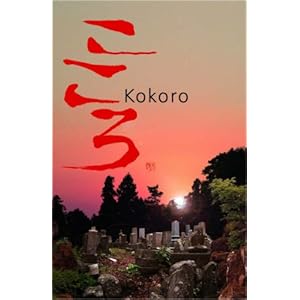
BOOKISH: Slowed to Sip Tea on Tatami: The novel is called "Kokoro"

Kokoro. It means heart in Japanese.  

[For this Post's inspiration, click: Getting to The Japan of My Fictional Dreams ]
 
Like Haruki Murakami and even more so like Yasunari Kawabata (Snow Country), reading Kokoro takes you into an Eastern frame of mind. This is perhaps a trite thing to say, but it is true. And like Kawabata, who won the Nobel Prize for Literature, Soseki, who died in 1912, is from another time, and in writing about a Japan that is more than 100 years old we get one of those deepest pleasures that only the intimacy of reading stories can bring: we are taken back to that other time, that other place. Slowed to sip tea on tatami mats in open old Japanese houses on hot summer eves.

Just that. It's almost enough. For the young man, the story's narrator, who so often seems to just kneel on tatami mats and wait, waiting to know the truth. For the wife, the one who is to pour the hot tea, who holds back so much of what she is thinking.

This is Meiji Era Japan, a Japan that had only just began to open its doors again to the world, a place so profoundly unique and not that ready to change.

Here, in these pages, no one is rushing toward anything else. The Tokyo noise described in the book is the noise of horse-drawn carriages and slow running trams. To get away from the big city to be by the sea, as the narrator does at the story's start, we feel as if the waves of that ocean never hurry to wash their way up the shore. The woeful pain at the heart of this intense story, it too takes its time to be revealed.

The writing is simple and sparse. The tone is one of great patience, of care - it is, in the writing and thus the reading of each word, each line, the idyllic sense of what it means to be Japanese.

Soseki's Meiji era Japan is a world so lightly drawn. That wonderful kind of writing that hardly seems descriptive and yet is so powerfully evocative. It makes me think of Hemingway. I should reverse that. It should go the other way (at least in terms of chronology). I don't know that Hemingway had access to Japanese texts, but like the Impressionists who could not have existed were it not for the Japanese art prints that influenced them, somehow there seems a connection between one of American's greatest writers and Japan. One critic compared Hemingway's prose to that of the Japanese haiku. That sparse, evocative style. A style so deeply inside writers as varied as Haruki Murkami, Raymond Chandler and also Raymond Carver.

How can a story be sad without being depressing? I once read (and perhaps even blogged about) a reaction Sean Penn had to seeing a piece of Hollywood fluff. He talked of how high he'd been lifted up by the movie and then the terrible drop that came after he was forced to return to the real world. He swore to stop seeing movies of that kind from that moment on. In a similar vein, I often find that the best "sad" stories are the ones that most honestly ease the suffering in my soul. Suffering: a Buddhist notion. Certainly one that pervades much of Japanese art. Kokoro is not a book that takes you from the world; rather, it draws you deeper inside of it

Even if you don't luxuriate in a perfect sentence or a remarkable economy of storytelling, to be taken back to a different era, to a far off land; this book takes you to that other place, the place we've wanted to fly to since we were little kids begging our parents for just one more story. But Kokoro is no fantasy. It is that more intense kind of literary reality.

It is considered Soseki's masterpiece, one of the great books of modern Japanese literature, and for good reason.

Tuesday, June 15, 2010

Getting to the Japan of My Fictional Dreams

Only now do I realize that I may well have already visited Japan long before I set foot in the country. Just as Holden Caufield running away from Pencey Prep one late December night took me with him on that fictional train to New York before I first visited that city, I'd been to Japan in books I read and movies I watched before ever touching down at Kansai International.

I've not gone back to it, but Arthur Golden's Memoirs of a Geisha was a novel I really liked in my early 20s and though, even after reading it, I'd not once considered going off to live in Japan until my cousin suggested it, perhaps the book got inside me. Closer to my actual departure, I saw Hirokazu Koreeda's After Life (Wandafuru Raifu in Japanese). The movie is set in an unnamed part of northern Japan. Much of the story, about a group of people who have died and are in a sort of in-between place, between life and afterlife, takes place in a very ho-hum simple wooden building or set of buildings. Only in Hollywood does death evoke bright lights and Enya-like music. Here there is no orchestral music, no Viennese choral choir of children. Here all is quiet, simple, rustic. It is winter and there is snow everywhere. Often when there is no talking we get that quiet only winter can bring - blankets of white silence over leafless trees.

A scene comes to mind: a young woman in a steaming Japanese-style bath, only her head above the water. The water is not moving. The girl is not moving. She sinks her head beneath the hot water to take a break and go deep within. She does not rush to resurface.

I remember a line from the movie: "I love the sound of snow falling," one character says to another, and perhaps already on some subconscious level I left Canada at that very moment, at the moment of watching, in search of this part of Japan. 

These things, these works of art, attracted me. They drew me in. Drew me closer to the place that would for 5 years become my home. So follows the nonfictional event, ie. something actual. My cousin Greg asking what I'll do next year. I'm twenty-four, just finishing my first degree. I say,

"I don't know. Get some shitty job and write."

He suggests travelling. I say, "yeah, but I don't want to return to Canada poor."
He suggests Japan. It's as unromantic as that. My head come out of the steamy water.

Eleven months later I am on that plane.


But the book and the movie. They don't just effect what we know, but what we experience. That great art gets in you, we've all hopefully felt. But that it becomes a part of you! It becomes your experience. Even a piece of music, how it can stay with you, change your mood, and even touch on the core of who you are and will be.

I think to myself: what fiction reader, what lover of the novel, if they're read Arundathi Roy, if they've read A Fine Balance or Vikram Seth's A Suitable Boy, what fiction reader hasn't wanted to visit India?

But even better, is if you have ever had the good fortune and keen sense to travel to a far off land, and whilst there read a little of that country's fiction along the way.

You ever done that? Read Hesse while hiking through the Rhineland in Germany? Read Murakami while staying at a ryokan in Tokyo, Japan? Or read The God of Small Things while stuck on a slow train, perhaps leaving Mumbai to visit Kerala, India?

I want to tell you about a book called Kokoro written by one of Japan's most famous writers. He was, until very recently, on the 1000 yen note (think $10 bill), and yet I know almost no gaijin who've even heard of him.

That'll be my next post. Of reading Kokoro in Japan and beyond. Of the way a place you were not born in, that you do not blood come from, can still seep its way so deep into your heart.

Kokoro. It means heart in Japanese.

See you then.

Friday, May 21, 2010

Great Short Story: J.D. Salinger's "A Perfect Day for Bananafish" I

The First of Salinger's Nine Stories 
[Introduced Here]

When perhaps the world's most famously reclusive writer died my father didn't write J.D. Salinger a letter. The Catcher in the Rye was not the reason my dad chose his profession (academia). And, as far as I know he has never read Raise High the Roof Beam, Carpenters and Seymour: An Introduction, never mind reading eight of the Nine Stories I'm here to speak about. But when you mention Salinger's name, my father always brings up "A Perfect Day for Bananafish" (1948), the story that opens Nine Stories.

My dad (Aba), it turns out, has good taste. This is probably the most famous short story ever published in The New Yorker

When Aba was just David and a teenager growing up in South Africa, a counselor at his (Habonim) sleepover camp read the famous story aloud to him and his fellow campers. I imagine the boys in their bunks on a humid night, clutched to the end of their beds' rusted metal frames, waiting to find out what happens next. Now a story, half of which is a phone conversation between a recently married bride and her mother wouldn't exactly seem a teenage boy's cup of tea. But then the best of anything is always so good as to break down the boundaries between man/woman, adult/child (think french fries, think a Van Gogh painting).

Inspired by this counselor's fireside idea, I read "A Perfect Day for Bananafish" aloud to a couple sets of friends when I was still living in Japan. (Said friends were not in bunk beds at the time). For perspective, in case you were picturing me regularly reading stories to strangers at my local Starbucks, the only other time I read aloud to people that aren't my wife, is when they are kids or when, more than a decade ago, I worked at a camp with autistic children (read them Charlie and the Chocolate Factory).

I've heard Salinger described as having a ventriloquist's ability - the way that he can inhabit the voice and nature of his characters. In "A Perfect Day for Bananafish" this includes: a little girl, a potentially mentally unstable man, a rather overbearing mother, and her rather superficial daughter. Each voice sounds right, sounds real. For the actor in me you can see why it would be a lot of fun to read aloud.

For the reader in you, Part II will, I hope, entice when you hear the sounds of those characters voices, and get a hint of the drive and depth of one hell of a brilliant yarn.

Click Salinger's "A Perfect Day for Bananafish Part II to continue reading.

Monday, May 10, 2010

Book Recommendation: Rawi Hage's "Cockroach"

The Dark and Lyrical Immigrant Experience in Montreal

Little need be said about this slim novel except that it was a jarring pleasure to see the sneaky, sly book classified as Canadian.

Lyrical and angry, poetic and sinister, this is not your grandmother's prairie novel. Montreal feels dark. The criminal is so sexual. The sexual so perverse. The vice is nice. This is how I feel inspired by this book; not to impart analysis on the author's political history (war torn Lebanon), because the book so masterfully manages to touch on the political without getting bogged down in it. Which is to say the dream is never ruined. The darkened streets are never lit too bright with some lecture. There are no lectures. There is little light. The beauty is in the darkness, and the flow of the language.

Amen to that.

Wednesday, December 16, 2009

Andre Agassi's "Open" - A Book Recommendation

5 reasons to read this book:


1. Because Andre has angst (he has always hated tennis, since the very beginning - see point 4.) and angst is interesting; and he doesn't skimp on the fast food binging, drug doing, getting love wronging details;

2. Because at heart this is a love story. And Andre, for wife and the school he set up for underprivileged kids, has a hell of a big heart;

3. Because like in any great book (fiction or non) you care about the characters. And really, who gives a crap about a meat-head musclebound trainer named Gil? Me. I fell in love with Andre Agassi's physical trainer the way I fell in love with Lee in "East of Eden" and I bloody loved Lee in "East of Eden." Or in a way, like how you fell in love with Rocky Balboa's couch, Mickey. Hint: it has to do with loyalty;

4. Because Andre's father is your worst nightmare of the athlete parent bastard breed and 'father was a bastard' stories are interesting, especially when Daddy was this callous, asshole, mean, selfish, wrong, complicated. 'Father was a bastard' stories are even better when son of said bastard becomes a world champion tennis player and not a bastard himself; and

5. Because the book is aptly titled. Andre gives every Brooke Shields-doubting-the-marriage (even while making the proposal) details. His gives of all the details, tells the stories you'd want to hear. Anecdotes like this one:

Agassi and his coach, Brad Gilbert, are having dinner at a favourite Italian restaurant after a match. By chance, Pete Sampras and his entourage are also at the restaurant, on the other side. As Pete leaves he comes by to say hi to Andre and Brad. After he goes, Brad tells Andre he'll bet him anything Pete didn't leave more than 5 bucks to the valet parking guy. Andre isn't as keen on finding out but Brad pushes and asks the teenager valet how much Pete gave him. The kid looks down, wants to do the right thing, doesn't want to tell. Brad pushes.

One dollar, the kid says. Pete Sampras gave the kid a dollar.

Commenting on this, Andre says, there is a world of difference between him and Pete.

Tuesday, September 22, 2009

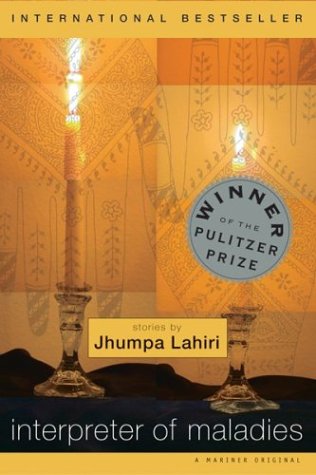
Jhumpa Lahumpa Lahiri at Angel Orensanz & Beyond

I think that I’ve always been someone more comfortable observing life ... intensely so as a child ...
-Jhumpa Lahiri (in conversation with Charlie Rose)


I once had a crush on a writer named Jhumpa
[pronounced joom-pa]
Last name: Lahiri
For years now
In my mind's ears and my poor wife's
She was Jhumpa Lahumpa
That's how I thought of her, how I referred to her
I couldn't stop

If you don't know, this is ridiculous
The London born, Bengali-Indian author from America
Her stories are not silly
They're New Yorker literary
Jhumpa doesn't write for kids
That's not her style
Not Jhumpa Lahumpa
Ahem, Lahiri
Sorry

No, but seriously
At 33
For her first book
Jhumpa Lahumpa
Lahiri!
Won the Pulitzer

It's that name
I can't stop converting it to Willy Wonka creations

Jhumpa, Lahumpa, zoomtitty doo

This is unfair
She is a serious writer
I have an actual anecdote

Last year I flew to New York to meet her
Truth told, I was to meet many famous writers
The annual New Yorker Festival

She'd share the stage with two other American scribes
Also with unique names
T. Coraghessan Boyle
And, really, what're you gonna rhyme that with
And Jeffrey Eugenides
Which only ever made me think of Eugenics
Which brings up the Nazis
And there's nothing funny about that
(Unless Tarantino, Roberto Benigni or Mel Brooks are involved)


But Jhumpa
Lahumpa
She didn't have to be funny
Her tense, realist, powerful stories sure weren't

The three writers were on a stage in a converted old synagogue
Angel Orensanz was the venue's name
Someone famous probably
I didn't google him
Left him a Sephardic Jewish left fielder in my mind
Angel Orensanz
If he'd been any baseball good
Shit, if he'd ever gotten to wear the pinstripes
They'd have had to name a fizzy citrus drink after him
Angel Orensanz
Ksh
Glug glug glug
Ahhh!

It was a Friday night
Sabbath eve at the old synagogue
Not that anyone seemed to notice

The writers were speaking

Jhumpa who had been Lahumpa
on that stage
In Angel Orensanz's wooden cathedral of a synagogue
Eugenidies and Coraghessan on either side
Up there she became Lahiri La-lousy

She was so cold and closed
As if she were angry to be there
To share
Not just uncomfortable
Because believe me, I was ready to give sympathy
To Jhumpa who had been
Lahumpa
We all were
Lovers of her Interpretation of Maladies
But this woman was downright contrary
What flow the other two writers on stage produced
Lahiri cancelled out
Like a negative bug lamp
Zapping any good buzz in the room
The Shul
The Orensanz

She was awful
Anti-social
Discomforting
Unsettling
Disagreeable
Awful

I couldn't help myself
Going up after
Joining the line of the many who went up after

No photo request
No, no, I don't want you to sign my book
Just hear my appreciation
Know my thanks
For your big-brassy talent
For the depth of your soul-shuddering insights

To the lined up folks before me
Lahiri was glass-eyed cold
That stage awful
It was also personal

Things would be different for me
For us
She and I
I knew
I was wrong
It was not
She shook my hand
She did not smile
Those cold eyes

There was no Lahumpa to this Jhumpa

Crush crushed
Romance over
I'd no longer even like her
It was decided

But then I heard that quote
That soundbite I wrote above
The half I wrote above
And the half I left to put here, below

...But I think that that’s really … always a part of me – the fact that I am very comfortable removing myself from actual experience.

It's not personal, Jon
You don't even know the woman
It's her books you fell for
Her short stories
Remember
I do
And soon
I'll return
She is that good
Jhumpa Lahumpa Lahiri

Wednesday, September 9, 2009

Dave Eggers' "Zeitoun" - A Book Recommendation

Have you ever noticed how the stories that make you feel the most, the ones that most stay with you are often novels, fables, legends, stories that are fictitious, imagined, about people who never were and yet who live so much more real in your mind's eye, springing as they do grotesque-evil or salt-of-the-earth-beautiful off that page.

The true stories we read, the non-fiction that we enjoy, while always stimulating often falls short somehow. I'd argue this is because news reportage and less crafted non-fiction typically stick so closely to the "facts" they bypass the feelings behind them. Writers of literary fiction, on the other hand, focus much of their attention on the reaction to events, rather than on the events themselves. The now very in-fashion genre that bridges the gap, that Truman Capote made famous with his desert island worthy "In Cold Blood," is often termed literary non-fiction. That is, a true story written not by a person that can type, but rather by one who has spent the better part of their life learning how to write.

"Zeitoun" is a book of literary non-fiction. As such, it's a gripping story and it is also beautiful, the kind of book you feel proud to own.

With the kind of simplicity that only a master craftsman can achieve (the Malcom Gladwell made famous 10,000 Hour Rule +++ or, in writing terms, the more than 1,000,000 words it takes), Dave Eggers' "Zeitoun" manages, like a world class film composer's score that you don't notice it is so seamlessly thread through the film, to make this true story strictly about Abdulrahman Zeitoun, a Syrian-American man who remains in New Orleans during Katrina and afterward. The writing doesn't once point the finger back at the artist, at Eggers, who is, by now [see my entry on the writer who is also a publisher, philanthropist and screenwriter if interested to see his many accomplishments and why I'm enamoured of him], a massive literary personality in his own right. It takes a good deal of ego to become a master of anything, and a great deal of humility to then cut down and spit-shine your writing so hard as to wipe off any of that egotistical grease you might be tempted to leave behind.

Plain, direct and with my favourite kind of simplicity (the Hemingway-made-famous deceptive kind), what makes this story so compelling is that not only do we get the immediacy of the Katrina debacle as seen through the eyes of a man who lived through it, but as with any heroic story, we get the kind of intimacy that only a book - in novelistic story sense - can provide, spending a few hundred tense yet often tender pages with Zeitoun; we get to know his family, his wife Kathy, an American who converted to Islam before she met her husband (itself a fascinating tangential story that Eggers is clever enough to slow down and tell in detail).

Like reading any great story about any great hero from a world not our own, like reading about a family from India, or a book about a young Jewish man coming of age in Montreal, this work of non-fiction brings us on side with a heroic Muslim man, which seems to me like fair retribution - this kind of empathy inducing tale - when considering the post 9/11 treatment so many Muslim-Americans, and, for that matter, all brown skinned Americans have had to endure in the paranoid post 9/11 world.

"Zeitoun" would be a fascinating story no matter who told it, but with Eggers at the helm, you get a great story told with economy, humility and with the killer critical element - the ability to take you, for instance, onto that metal canoe with Abdulraman, so that you paddle down the streets of New Orleans with him, so that you endure all that follows with him. So that you too can know what this storm did and what abhorrent actions the Bush administration took, and what critical ones they were foolish and heartless enough not to take.

Great imagination is rooted, they say, in empathy. For years I mulled this one over not exactly sure what it meant. I can articulate it now, after having read this powerful story. Eggers digs deep into the life experience that one family endures and in so doing allows us to live those experiences with him. The best books don't just let us escape, nor is it just that they make us think; it is the feeling, it's the empathy that's key because if we don't get to care deeply about the characters involved, why complete five pages of the thing.

I completed 335, and fast.

Tuesday, September 8, 2009

Lloyd Jones' "Mr. Pip" - A Book recommendation


Go away to an island, a place of myth based on real. A fable story that has a "Little Prince" ability, a Murakami ability to get your imagination flowing but is also political without being big P political. I.e. Interesting, but still fiction story stunning. The magic that was the transporting reason you went to books as a kid. That kind of book. But for grownups.

Sunday, July 26, 2009

Amelie Nothomb's "Tokyo Fiancee" - A Book Recommendation

Who's Amelie Nothomb?
-massively successful author from Belgium who now lives in Paris but was born in Kobe, Japan and spent first five years of life there, raised by a Japanese nanny.

What's "Tokyo Fiancee" About?
-a Belgian woman named Amelie who was born and raised in Kobe by a Japanese nanny returns to Japan in her early twenties. She tutors French and has a relationship with her one and only student, a shy, young Japanese man named Rinri.

So It's Really About:
-the nature of love, but a very modern love where the independent woman is the one trying to keep her lovesick boy at bay
-Japan (Mt. Fuji, ramen noodles) but in a lived there honest way

Why Read
(i) - Unabashed Honesty.
Amelie goes to art exhibit, approaches haughty artist of show that all have been fawning over but who's work Amelie finds dreadfully boring.
"Excuse me, but I cannot seem to understand your art. Could you explain it to me?"
"There is nothing to understand, nothing to explain," he replied with disgust. "It is meant to be felt."
"Precisely - I don't feel anything."
(ii) -Captures Japan but exactly, as well as the less talked about sides of love.
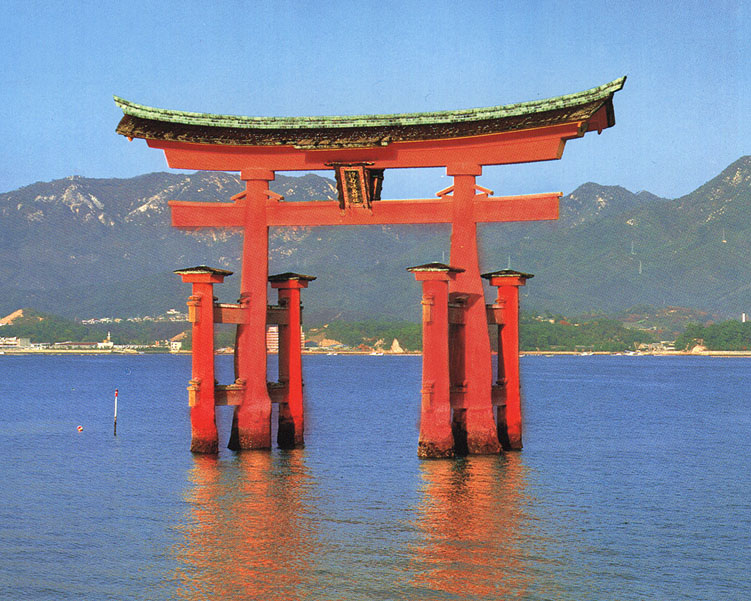
"On the boat a loudspeaker was broadcasting sappy songs. We docked by a torii [famous Miyajima torii pictured], disembarked and set off along a well-marked poetic path. Couples stopped in spots specifically conceived for the purpose and gazed with emotion at the view of the lake through the torii. Children whined, as if to warn all lovers of the future that awaited them after so much romanticism. I was having a good time."

Tuesday, June 30, 2009

Haruki Murakami: Where to Begin? 5 Best Bets to Start

Where to begin ? It's not like with Salinger where the answer would of course be The Catcher in the Rye (with the critical addition of not letting the reader stop there, forcing them on to the "Nine Stories" of course and then "Franny and Zooey" and last but certainly not least "Raise High the Roof Beam, Carpenters - bar none the least inviting title to a fucking brilliant story.) With Murakami it depends on the person reading. Is this reader a lovelorn romantic, or more the type to need a meaty, weighty book? Do fantasy and wonder appeal? Or is it just a straight but rather surreal adventure that is the order of the day?

The following is an attempt to help solve the problem:

Norwegian Wood
--For melancholy love and what seems so simple a story, but that carriers a similar mystique magic to J.D. Salinger's The Catcher in the Rye

Hard Boiled Wonderland and the End of the World
--For the adult reader who doesn't believe there are fantasy books for adults, books that can take you into your imagination the way they did when you were a kid, but that are actually written for people who've outgrown George Lucas (more or less).

Dance, Dance, Dance
--For the utter fun pleasure of a magical mystery kind of tour - this is a thrill ride for the literary reader. [For a wee review follow me.]


The Wind-Up Bird Chronicle
--For what many consider to be his first masterpiece, and what I have to call the best opening to a book I can think of.

Kafka on the Shore
--To confuse everything this may well be my favourite Murakami book of all, but it comes last and gets no real descriptor because I don't think it's the way to start if you're not familiar with the author. Start with the very good, warm your way to the great.

Wednesday, May 20, 2009

Ray Bradbury's Zen Wisdom


In "Zen in the Art of Writing" Ray Bradbury tells the story of how when he was just a wee lad (though Bradbury never actually refers to himself either as wee or lad), maybe 8 or 9 years of age, he loved loved loved Buck Rogers. But his friends teased him for it. That he was so obsessed with some sci fi comic book character. That was just silly. So, little Ray took all his stacks of Buck Rogers comic books and hid them away, under his bed, as I imagine it. Enough was enough.

A few weeks later, though, and young Ray starts feeling lousy and can't figure out why. He then realizes it's because he misses his beloved Buck Rogers. He, thusly, pulls back out his stash, dusts them off and says good riddance to those friends that had teased him.

In the book he speaks to what amazing fortune he had, to have figured out at such a young age what many of us don't learn till much laster in life (if ever).

He ends the anecdote by addressing the would-be-writer, saying that if your friends don't support your dream they aren't real friends. Go get new ones.

But who has the balls to do that? Do I? Do you?
Follow mendelsohnjon on Twitter