Showing posts with label Haruki Murakami. Show all posts

Tuesday, April 19, 2011

Desert Island Novel to Read and Read and Read Again #1: Haruki Murakami's "Norwegian Wood"


[Originally published November 28, 2008]


I once had a girl
Or should I say, she once had me


I was living in Osaka, Japan, teaching at a conversation school in a place called Takarazuka the first time I read "Norwegian Wood." When I reached the last page of the novel, after reading its pitch-perfect last line, due to an utter unwillingness, a near inability, to leave the beautiful world Murakami had created, I proceeded to immediately flip back to the first page and start all over again. That was seven years ago. I've read it again since. More than once. I've also gone on to read and buy every book of Murkakami's translated into English, including his short story collections, and non-fiction.

Why? Because "Norwegian Wood" hit a place in my soul, it became a mate to my soul, a heart to beat along next to mine.

The Beatles song Murakami's 1987 novel is named after is on surface listen a pretty two minute ditty. A pretty, but sad, thing. The tone of Murakami's novel has something similar gently pulling the reader through. It is also equally deceptive to the song in how simple it seems, how easy it reads. Yet, beneath a book that reads like almost pure autobiography, and a song that listens like effortless melody, lie layered artful structure, and things thematically heavier than meet the eye.

The Beatles' song that is so melodically sweet ends with a man taking revenge on a girl who would not sleep with him, by burning down the furniture in her room.

Murakami's narrator does no such thing. But his book too juxtaposes a gentle tone with themes of longing, of loss and of what can and will never be.
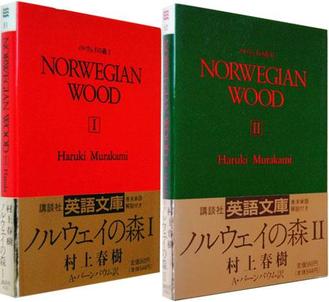


To be intentionally vague (no plot spoilage here) and very brief, "Norwegian Wood," set in the Tokyo of the 1960s, is a love story. Basically it is a sad story. Most all the love in the book is of the unrequited variety, and there is more than one suicide. The book has much to lend itself to feeling blue, like Miles Davis on his muted trumpet. But for every lonely moment, you get a scene with a character like Reiko, a friend like Reiko, a woman who should be tragic considering her history but who, by the time we meet her in a sort of sanatorium for sad or screwed up people, turns out to be that rock solid salt-of-the-earth type who seems like the mentally healthiest person in the book. Better still, though no longer the piano virtuoso she once was, she plays a mean guitar, Beatles song included.

The magic of Murakami's "Norwegian Wood," is that a book so focused on sad subject manner manages to have what all books need to be great - a sense of adventure. Not, of course, in the children's literature sense of the word, but in the 'you've gone off to another place' sense.

... the bus plunged into a chilling cedar forest. The trees might have been old growth the way they towered over the road, blocking out the sun and covering everything in gloomy shadows. The breeze flowing into the bus's open windows turned suddenly cold, its dampness sharp against the skin. The valley road hugged the river bank, continuing so long through the trees it began to seem as if the whole world had been buried for ever in cedar forest - at which point the forest ended, and we came to an open basin surrounded by mountain peaks. Broad, green farmland spread out in all directions, and the river by the road looked bright and clear. A single thread of white smoke rose in the distance...

Best of all is the poetry is in the book's balance, as alongside depression and suicide, you also get a character like Midori - one of my favourite in all modern literature.

At 5:30 Midori said she had to go home and make dinner. I said I would take a bus back to my dorm, and saw her as far as the station.
"Know what I want to do now?" Midori asked me as she was leaving.
"I have absolutely no idea what you could be thinking," I said.
"I want you and me to be captured by pirates. Then they strip us and press us together face to face all naked and wind these ropes around us."
"Why would they do a thing like that?"
"Perverted pirates," she said.
"You're the perverted one," I said."


And really, what else do you need to help you cope with death, and the kind of love that will never be, but perverted pirates?

[Click J.D. Salinger's The Catcher in the Rye for Desert Island Book to read and read and read again # 2]


Thursday, March 3, 2011

The Five Books I Most Often Recommend at the Book Shop Are:

1.

--For its epic scope, its great story and its literary quality (probably the safest bet to satisfy the book club goer, the Oprah lover and the snob), Middlesex is a beaut. 

2.

 
--Click East of Eden for the reasons why

3.

--Click Dance, Dance, Dance for the reasons why;
--The Wind-Up Bird Chronicle - because it is widely considered Murakami's first masterpiece and is good for anyone looking for something meatier, denser, more all-encompassing; also that bit of (Japanese) history seems to ease more readers into the belief that what they are reading is "real" literature;
--Hard Boiled Wonderland and the End of the World - for sheer wonder and sparkling imagination

 4.

--Click All the Pretty Horses for the reasons why; and

5.
 

--For being my favourite collection of short stories published since Salinger's Nine Stories and winning the Pulitzer on what was Jhumpa Lahiri's first book, The Interpreter of Maladies is a stunning debut.

Wednesday, January 12, 2011

BEST of PBIHT: Portrait of a Mentor: At the New Yorker Festival with Haruki Murakami

There was a small table with a pitcher of water and two glasses on the stage, two chairs on either side of the table. The talk's moderator, New Yorker Fiction Editor Deborah Treisman, sat on the one side. Haruki Murakami, his legs crossed, sat on the other. He was wearing a creamy beige suit over a white t-shirt so washed-out the Tide laundry detergent brand in the dead centre of his chest was almost as white as the T-shirt. His shoes, like a narrator from one of his novels, were very faded red sneakers.


His hands were in his lap and he spent much of the afternoon's talk looking down at them. When he looked up, to punctuate a point, say, you saw the full colour in his cheeks. He is in his late fifties, but all his marathon running and highly, highly disciplined life show in his glow. He looks healthy, happy.

You can't fake humility. You can think you can, but you can't, and Murakami was not faking it, and this is a guy touted to win the Nobel Prize. It's not that he is so daft as to not realize how big a literary celebrity he is. But nor does he do as I'd seen the writer Jhumpa Lahiri do at a New Yorker festival event two days previous - so overwhelmed by her fame as to selfishly reject it, playing that celebrity 'I hate that you love me' game (a rather lousy move to an audience of people who've paid to see you, and who just want to come up afterward to shake your hand and thank you for what you've given them). Murakami wasn't rejecting it because he doesn't take himself or his status so seriously as to allow that to be a central issue of his life.

Previously, I wrote on my being mentioned in the New Yorker's blog on this very talk, and included the blog itself. It highlighted many of the anecdotal threads of wisdom the famous novelist had to give. But the blog, in its probably strict requirement to be pithy, couldn't capture the whole thing (and maybe few people other than hard-core Murakami nerds like me care), but I feel the need to add a little, like the ambience in the packed theatre that the man created. Online the New Yorker mentioned Murakami outlining harmony as one of the three essential elements in his fiction. What wasn't mentioned was the balance this man gives off not just in his prose but in his presence, the way he sits, the way he takes his time to think over a question; a long time before he will start to speak; an act he also is in no rush to babble through. Murakami does not babble.

This is a guy who drinks little, is early to bed and incredibly early (as early as 3am) to rise. He described all of his working endeavours, including writing, translating and revising, as fun. That he used the word 'fun' was mentioned. What wasn't was the number of times he said it, and how childlike-sincere he seemed to be when he did.

As well there was an audience member's astute observation that reading Murakami is a calming experience. That's why millions around the world are reading not one but all of the guy's novels. This not to say his novels are without their darkness. They almost all delve deeply down the dark well. Yet even in the digging there remains a kind of serenity.

Murakami so embodies a spiritual calm it all but changed the way we audience members breathed for a couple hours of a Sunday afternoon (I don't even think I'm exaggerating). Though he never discusses religion, and as far as I know is not in any way a religious man or even affliated with any religion, I think his grandfather (or was it his father?) was a Buddhist priest. This doesn't seem coincidental.

Speaking of Buddhism, I doubt I am the only person to walk away from watching their favourite living writer wishing that they too could diminish their ego to that degree.


[Originally published in October 2008 when I was still high from having just seen my idol in person. Happy birthday, Murakami-san.]

Wednesday, October 20, 2010

Desert Island Novel to Read and Read and Read Again #7 - Haruki Murakami's "Dance Dance Dance" (or "Dansu Dansu Dansu" in Japanese)

[For Desert Island Books to Read and read and read again # 6 click Ernest Hemingway's Fiesta: The Sun Also Rises]


PART I 


Surprise Ain't the Only Thing That Translates
At the New Yorker Festival talk Haruki Murakami gave a couple years back, describing the effort of writing books, I swear Japan's now most famous author must have told the audience that writing was "fun!" at least five times. And when I say "fun!" I  mean that he said it (I know, I was there) with a near shoulder-shrug, high-pitched ease, like the way your ten year-old nephew would nearly indifferently describe his gloriously perfect day at Canada's Wonderland. Murakami wasn't being obnoxious; he wasn't saying writing a novel like Dance Dance Dance was easy; he was just trying to say that he enjoyed the process as much as he did. Still, you're sitting there listening to your favourite writer, taking furious notes like the wonder-student you never were, hoping to learn a few things, and there he is shoulder-shrug, high-pitched saying, "It's fun!"

You think I wasn't jealous?

There's an expression popular amongst those of us with writerly aspirations: No surprise for the writer, no surprise for the reader. If you've plotted and planned out every detail of your book you'll never truly throw your reader for a loop. If, however, on page 342, as you're finishing your first draft, you realize that - holy crap! - your heroine is going to commit suicide, chances are you'll be instilling a rather holy crap feeling in your reader as well. They never saw it coming and how could they? You didn't either.

This of course doesn't only apply to surprises. Joy also translates and that fun Murakami feels in the crafting of his stories is evident throughout his extensive body of work. There is, as I've said on this blog before, a lightness to his stories no matter the subject matter. I don't mean they're all airy-fairy popcorn (for airy-fairy popcorn see Banana Yoshimoto). They aren't. But even when death is a theme it manages not to veer into the hopeless or nihilistic. His stories can get sad; they just never seem hopeless. There is an acceptance there, an always calm acceptance of what life is, of what it will deal. In turn, there is always a light behind, beyond or just the other side of whatever darkness Murakami might present.

As the Kyoto born novelist has said, he is always looking for balance in his writing and thematically he is unparalleled at coupling light with dark, especially in his later works.

In none of his novels, however, is there anywhere near as much fun (and not all that much dark) nor as many flights of fancy - to my mind, at any rate - as with his sixth novel, Dance Dance Dance (1988), a book so much about the "advanced Capitalist" age we're in and how much of our lives are now spent killing time, or trying to figure out how to kill time. To be honest the novel does very little heart breaking, but I'll call it soul healing and it does (heal my soul) by dint of its glorious ability to take me to another world - that bedtime = story time thing we've forever asked of fiction, especially on cold, wet autumn eves.

Planes, (Bullet) Trains and Subarus
There's a movie about to be released in theatres about a guy stuck in a wooden coffin. That's the setting for the entire feature. A coffin. Sounds about as pleasurable as being ... well, stuck in a coffin, which I suppose is the film's claustrophobic point, but doesn't sound like any kind of entertainment I'd enjoy. In my stories I like movement. Even on stage I've always preferred if there could at least be a kitchen for a character to walk over to and pour a stiff drink, so that you're not always just stuck in that living room. People talking in one room for scenes on end makes me tired.

I am, I fear, the same way in life. My favourite kind of dinner party allows me to be at one table, then another and then outside with the smokers (I haven't smoked cigarettes in years but haven't stopped sympathizing with and understanding the break-away-from-group-need that is so much of what feeds the habit).

I love Dance Dance Dance for its sense of adventure - for the various journeys it takes you on. The story doesn't stay in one place or even one city or even one country, and crap, it turns out the limitations of my life are such that I can't hop on airplanes nor afford bullet trains and go on vacation on a monthly basis. A book ain't a bad alternative sometimes. 

When I revisit The Catcher in the Rye I always forget how long the opening chapters in Holden Cauflield's school, Pencey Prep, really are. In memory the story spends a few pages at the school and then we're off and running away from school in the night with this teenager, spending the few days and nights that follow round New York. Going back, though, I realize there's a significant and rather dense portion of text (and the time required to develop some truly memorable characters - pimple popping Ackley kid, any Salinger fanatics out there?) set in the school. I mention this here because if one of the funnest things great books do is take you on a journey, then the only way to do that is by firmly situating you someplace first.

With Dance Dance Dance Murakami situates us first in Saporro, on Japan's northernmost island of Hokkaido, which has a lot in common, I'm told, with Canada. (Canadians visiting Japan don't always gravitate to those northerly locations with climates and snow falls and greenery simliar to home - go figure.)

The streets were covered in a thin layer of slush, and people trained their eyes carefully at their feet. The air was exhilarating. High school girls came bustling along, their rosy red cheeks puffing white breaths you could have written cartoon captions in. I continued my amble, taking in the sights of the town. It had been four and half years since I was in Sapporo.

And whilst there the narrator is staying at the Dolphin Hotel, a once shoddy place that has now been demolished, replaced by an over-branded five-star hotel. So there you are in the slush and snow, or in the hotel lounge watching the swirling snow while sipping your drink and then he has you - I mean the narrator - sort of fall in love with a woman who works at the hotel's front desk before you're flying to Tokyo with a rather precocious thirteen year-old girl (speaking of Holden, and this is not Murakami's only novel with such a character - did I mention that Murakami wasn't satisfied with the Japanese translation of The Catcher in the Rye and so did a new translation himself a few years back?). And then it's her story, the thirteen year-old's (Yuki's) and the story of her clueless mother, who is a great artist but a terrible mother (eg. leaves her thirteen year-old to fend for herself in Sapporo, when home is Tokyo).

So now you're in Tokyo where you'll meet a movie star you once knew in high school. In Tokyo, back in your apartment, with your little Subaru and your music and your kitchen where you can cook the dishes that'll make all your readers ravenous (more on that later).

But just as you've settled into a book set in Tokyo, a hundred pages later (give or take - I didn't count) and you're suddenly on a trip to Hawaii. And really, who doesn't like to take spontaneous trips to Hawaii? Who, for that matter, doesn't want to read a book that makes you hungry and horny and so much more?

For that you'll have to click on Murakami's "Dance Dance Dance" that makes me hungry and horny Part II.

Monday, July 20, 2009

Great Book Openings: Haruki Murakami's "The Wind-Up Bird Chronicle"


When the phone rang I was in the kitchen, boiling a potful of spaghetti and whistling along with an FM broadcast of the overture to Rossini's The Thieving Magpie, which has to be the perfect music for cooking pasta.

Tuesday, June 30, 2009

Haruki Murakami: Where to Begin? 5 Best Bets to Start

Where to begin ? It's not like with Salinger where the answer would of course be The Catcher in the Rye (with the critical addition of not letting the reader stop there, forcing them on to the "Nine Stories" of course and then "Franny and Zooey" and last but certainly not least "Raise High the Roof Beam, Carpenters - bar none the least inviting title to a fucking brilliant story.) With Murakami it depends on the person reading. Is this reader a lovelorn romantic, or more the type to need a meaty, weighty book? Do fantasy and wonder appeal? Or is it just a straight but rather surreal adventure that is the order of the day?

The following is an attempt to help solve the problem:

Norwegian Wood
--For melancholy love and what seems so simple a story, but that carriers a similar mystique magic to J.D. Salinger's The Catcher in the Rye

Hard Boiled Wonderland and the End of the World
--For the adult reader who doesn't believe there are fantasy books for adults, books that can take you into your imagination the way they did when you were a kid, but that are actually written for people who've outgrown George Lucas (more or less).

Dance, Dance, Dance
--For the utter fun pleasure of a magical mystery kind of tour - this is a thrill ride for the literary reader. [For a wee review follow me.]


The Wind-Up Bird Chronicle
--For what many consider to be his first masterpiece, and what I have to call the best opening to a book I can think of.

Kafka on the Shore
--To confuse everything this may well be my favourite Murakami book of all, but it comes last and gets no real descriptor because I don't think it's the way to start if you're not familiar with the author. Start with the very good, warm your way to the great.

Monday, October 6, 2008

The New Yorker Festival with Haruki Murakami

The following was posted on the New Yorker blog about the magazine's annual Festival. You may recognize the question asker from Canada with Japanese wife.

Somebody’s Got to Do It
[From: http://www.newyorker.com/online/blogs/festival/]
At the Haruki Murakami interview, there was a faint sense of siege. Tickets had sold out in eleven minutes. Up in the nosebleeds, people were pleading with an usher to let them sit on the stairs. (She was firm: “It’s against the law.”) On stage, the writer belied his rock-star reputation, glancing shyly at his feet. He began by telling the story of a jazzman who, when accused of playing “just like Charlie Parker,” handed his saxophone to his critic and said, “Here—you try playing like Charlie Parker.” He said that we should draw three conclusions from this:

1. Criticizing somebody is fun and easy.
2. Meanwhile, creating something original is very hard.
3. But somebody’s got to do it.
He went on to reveal his writing secrets:

On inspiration: “I became a writer all of a sudden. I don’t know why.”
On the three essentials to literature: “Reason. Harmony. Free improvisation.”
On momentum: “I wanted to turn the pages, but there were no pages—I had to write them. I don’t know what’s going to happen next, so I write it. And then I don’t know what’s going to happen next, so I write it.”
On happiness: “If the protagonist is happy, there’s no story at all.”
On the toughness required to be a writer: “You have to be Rocky.”
On writing in general: “It’s fun.”
An audience member rose. “I came all the way from Canada to hear you,” he said. “My wife is Japanese, and we met through talking about your work. She couldn’t come today, but she wanted to say ‘Konnichiwa.’”

A voice piped up from the other side of the room: “I came from Australia, so I beat you.”


And So he did. But speaking of beating, never in my life has my heart pounded so hard, and I was so nervous to have approached that mic in that theatre, so embarrassed that I'd taken up the time. I returned to my seat and absolutely uncharacteristically of me couldn't look at another person the rest of the event, and even when exiting, scurrying, wheeling my carry-on quickly out the theatre and down to 53rd street to catch a bus to get to Newark in time for my flight home, to see my beautiful wife, I felt pretty small. Small in the best way small, the way Murakami had made shy seem so good. Self-effacing as an ideal.


Still, as I got close to home, to my family, I thought: Have I got a story for you.

Tuesday, February 6, 2007

Published Book Review: Haruki Murakami's "Blind Willow, Sleeping Woman"

[previously published in the December 2006 issue of the Kansai Time Out]

J.D. Salinger published seven of his Nine Stories in the illustrious New Yorker magazine. Two were rejected. Of the 25 stories that make up Blind Willow, Sleeping Woman, the third (translated to) English collection of short stories by Haruki Murakami, nine were published in the New Yorker. Like Salinger, Murakami’s fiction not only has literary cache (rumor has it he’s now being considered for the Nobel Prize), his books sell millions of copies around the world.
Blind Willow, Sleeping Woman is a career spanning collection that includes two of the first short stories Murakami wrote 25 years ago through to stories published last year. In this collection we get both the surreal, with stories of talking monkeys and of icemen who date Japanese women, and we also get the real, with stories about everyday people dealing with cancer, sexuality and the loss of their children.
At their best these stories, like Murakami’s strongest novels, sink deep within the reader’s psyche. His stories have the power to make you dream differently. How Murakami does this may seem beguiling. The secret, I believe, is in the balancing. Murakami grounds the surreal stories in the mundane while managing to bask the realistic stories in an other-worldly glow. In “The Iceman” the main character meets the iceman, her future lover, in the lobby of a ski resort. There the iceman is, just reading a book. In “Blind Willow, Sleeping Woman”, on the other hand, Murakami turns a simple bus ride through the woods into a moment out of a dream. The story begins, "When I closed my eyes the scent of the wind wafted up towards me." The narrator compares the May wind coming through the bus window to the breaking open of a fruit. "The flesh split open in mid-air, spraying seeds like gentle buckshot into the bare skin of my arms, leaving behind a faint trace of pain."

To slip into Murakami’s world, to get into his stories never feels like work and the trick, again, is in the balance. In an era of not knowing how to slow down, Murakami’s stories never feel rushed. There is always a slow easiness to them no matter how heavy the topic, death and loss being common themes. And though the stories never feel overly dark or depressing, rarely do we get serenity without a sense of its exact opposite. In “Man Eating Cats,” a Japanese couple lives the perfect life on a Greek island. Each day is spent eating the simplest foods, drinking wine and making love. What the narrator describes as “the most peaceful time” in his whole life doesn’t last. The narrator’s girlfriend goes missing, the story ends and we’re left with no indication where she went or that she will ever be found.

Like most Murakami fiction the “point” of these stories is not always clear. Readers looking for straight narratives with lesson-drawing endings may feel frustrated, like they don’t "get it". The stories are more for those who can relate when a character in “A Poor Aunt Story” says, “For some reason, things that grabbed me were things I didn’t understand."

What is clear is that the 25 stories in Blind Willow, Sleeping Woman linger in the mind like lucid dreams; carrying you along like a gentle breeze while containing enough weight to resonate.

Follow mendelsohnjon on Twitter
