Showing posts with label Japan. Show all posts

Tuesday, May 17, 2011

BEST OF PBIHT: A Buddhist Bus Ride - Pt I

[Originally posted November 2009]

No one longs to be a cliche. They don't fly to Japan planning to be yet another white guy who brings back a Japanese bride. They don't fly to Japan with the intent of going Zen, never mind espousing theories of Buddhism.
But they do. They do it all. Marry the Japanese girl, sleepover at a Buddhist mountain top with all the other white tourists. Books by the Dalai Lama become toilet readings. Attempts at meditation become commonplace. (These aren't attempted on or near a toilet.) The very act of sitting at dinner or desk a little more straight-backed rings spiritual in their Western heads.

The world, though, is of course getting smaller. The East now dreams as Hollywood West prescribes, while the West rushes with their Japanese wife to a yoga class every Thursday night at the local community centre (it feels sooo good after).

East or West, what interests us, however, what we aspire to, is not who we are in the now (unless your surname is Lama). Otherwise, duh, we'd already be there.

No, in the now we can be really fucking annoyed, and sometimes overwhelmingly mad especially when on a long and crowded bus.

LIFE IS SUFFERING
The Buddha, even before he was the Buddha, never took the bus. For one, his was a time before buses; and two, he was originally a prince, ie. rich, therefore above bus taking. 

Ergo the rich need not read this post. They don't know from buses. Shit, the middle class barely stray beyond a subway in Toronto unless they absolutely have to. No, the moneyed don't know from this pain (I'm assured they have other pains to deal with). For all the rest who regularly take buses, you know that buses have gotten busier, traffic angrier. You know the urban expanding reasons. You know also from where I ache - eg. the very depths of my soul. 

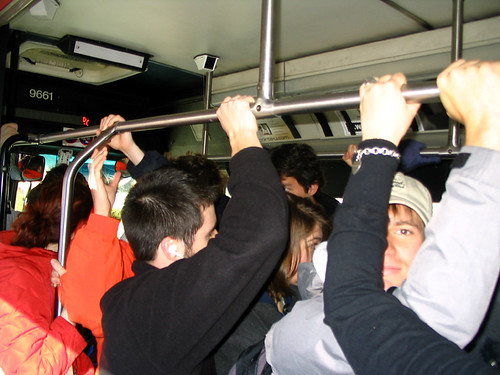
The ache I regularly take is a busy and lengthy bus ride, much of it filled with the headphone-leaked ootza-ootza (as my friend Sonia puts it), techno music beats, and the never quiet conversation treats of the teen-aged. There's everyone's favourite, the elbow jostle for a bit of 'do you mind if I actually sit back in my seat' room. There's the supreme misfortune of being stuck in a middle seat between men, when the whole ride is a knee wrestle for territory, like dogs pissing, but with knees. (Being of the gender, I'll 'man up' and admit my knees, both the right and the left, have more than likely been the cause of not a few others' misery, tuck in my legs as I think I might.) This just to name a couple instigators of the pain, and these only if you're lucky enough to snag a seat. 

The Ride Continues Thursday.  

Monday, May 2, 2011

BEST OF PBIHT: Tokyo Tomato Part II

Continued from Part I

Entering Maduro
I think the hotel receptionist phoned up to the jazz bar, called Maduro, because she didn’t quite catch my English, or lack of credentials. I was welcome, she smiled, if plastically, to go up to the fourth floor and take a look, though the bar wouldn’t open for another hour.


The elevator opened onto a wide sidewalk-like path, which ended at what I could only assume was the bar's entrance, a tall, heavy slab of polished tan wood set into the far end of an otherwise purely grey concrete structure. With no handle to pull or indication of where to push, I was much relieved when as I took the final steps toward it, the big hunk of wood slid effortlessly aside.

I found myself - the door quickly sliding closed behind me - in a dim, narrow passage. On the counter to my right, where I imagined the hostess would greet customers, was an old-fashioned desk lamp with green shade. There was a black curtain to my left blocking my view of most of the bar. I could see a sliver of it ahead, though, some plushy maroon chair backs, the small not lit stage beyond, a drum kit. There was the distant sound of a vacuum come on then suddenly turn off. I may have gotten a shiver. The darkened empty bar evoked Stanley Kubrick anxieties and I was just about to call out, somewhat Shelly Duvall shrilly, for someone when the manager, or probably the assistant manager, emerged so spookily, but somehow not threateningly, out of nowhere it was less like “The Shining” and more like a cartoonish villain from a Scooby Doo cartoon.

The short, thin man in his fitted black suit didn’t - how shall I put this? - seem to have participated in a great deal of love-making he was so stiff-backed. He barely even attempted to fake an awful smile, not missing the quality of my outfit, my hiking shoes. He waited for me to speak. I was a journalist, I explained. This was somehow less impressive to him than I may have hoped. I scrambled to think up some questions.

All I learned from this uptight little man was that the band went on at nine. I’d be coming back to see them, I explained. He pursed his lips, nodded. Did they have any discounts for journalists, special prices on drinks maybe? Did he know? He nodded. He was sorry. No.

At The Altar of the Single Malt
I couldn’t have just left at that point. That would have been obvious. (Because thus far I had been sooo successful at fooling the man.) I asked if I could look round the bar.

He let me too, but only, I think, because it wouldn’t cost him anything. I pulled notebook from knapsack, clicked on my 105 yen pen and slow-walked around the windowless room jotting notes. I did this for as long as I thought I could
get away with it – five, six minutes.

I’ve since learned it’s damn near impossible to get a free lunch in Japan. In a land that is downright German in its love of uniforms and rules, I had yet to encounter a movie theatre usher who’d just let me in for free, no matter what the complaint or how subtle the charm. Where bureaucracy reigns supreme, there is little space for charisma (or a blatant disregard for the rules, for that matter).
Before leaving Maduro I went up to the bar. Approaching it reminded me of the feeling one gets walking up the centre aisle of St. Peter’s Basilica in Rome – a not dissimilar awe-inspiring experience. Of course, instead of Jesus and cross you got single malt scotches lined up in neat rows. There were also four giant champagne flute-like thingys hung high above, flames burning in each. Blocking most of a giant mirror behind the bar was a plant the size of a small tree. I nearly missed the bartender quietly working away amongst the grandeur. He seemed willing to answer a few questions. The Mojito was their most popular drink, a glass of 1947 Macallan was the most expensive at $420 a glass.

I was just about to go when a large Caucasian man entered the room wearing the kind of dirtied three-quarter length white coat that suggested he had either just come out of surgery or else he worked in a kitchen. I approached him because of his warm smile. His name was Franz. He was the executive head chef in charge of all five of the hotel’s restaurants. He was, with the soft (brown) eyes and confident belly of a good father, glad to talk to me. But could I come back a little later?

At 6:30 I was to meet him at The Oak Door, the hotel’s steak restaurant.


The final chapter in the tomato saga drops Thursday, in which a Japanese tomato has a more than likely chance of making an appearance.

Friday, April 29, 2011

BEST OF PBIHT: Tokyo Tomato - A Story

[Originally published quite some time ago...]


One cannot live on tomato alone, but one can be very, very inspired by a tomato.
-J. Mendelsohn

THE RUT
All the thrills of crossing the ocean, the many memoirs of geisha I planned to write, and I was stuck in the rut of a routine that was killing me. Turns out the English Conversation schools that set you up with work visas and apartments expect you to work in return, the bastards! They aren’t paying you to sightsee or write the great novel. I hadn’t gone to Osaka for this. To teach eight conversation classes a day. Yes, at first it was the easiest job ever because you’re paid to chat. That’s what the students want. But give it a couple weeks and you’ve long since run out of conversational material. It’s not like you can assign in-class work either. Your job is to chat, to always be "on," engaging and entertaining like a clown without the makeup or a psychiatrist without the sedative; you don’t even have a set of steak knives to sell to give the interaction some purpose. And believe me, after eight hours of being "on," even the most loquacious conversation teacher goes mute.

This was the opposite of inspiration. This was dispiration. Once again I was living for every lunch break, end-of-day, day off and – dare I say – holiday? They get them in Japan too, sometimes.

When the long weekend in May finally came, I hopped a bullet train to Tokyo. I’d have yelled FREEDOM out the train windows with a bad Scottish accent but I feel conflicted quoting old Mel Gibson movies. Also, the windows were the kind you couldn’t open.

SHEEP IN CHRISTIAN SLATER'S CLOTHING
They say the hardest truth of travelling is realizing you must take yourself wherever you go. I’m not so sure. I’ve been other people all over the place. Like back in high school when I pretended I didn’t like reading and wore a trench coat to travel downtown, to smoke cigarettes and perfect my pool game and impersonate Christian Slater impersonating James Dean. The good sheep from the white suburbs turned baaad, scamming free meals I’d convince fast food managers to give me for some “mistake” one of their employees had made the day before (an alleged allergy to onions or something). After that I learned to complain my way into movies, into concerts; I even scammed my way into a Leafs game once, a playoff game.

I could be other people in Tokyo as well.


JUST LIKE THAT
Roppongi Hills is a new, super-fashionable district of Tokyo. I was supposedly there for the museum, but really I cared about the newly built movie theatres with their first-class seats and their high-rise tall screens. It was by accident that I came upon the Tokyo Grand Hyatt (like a regular Hyatt, only a five-star hell of a lot more grand). I already had my ticket for a George Clooney movie and had time to kill. So the hotel.

As soon as I walked through that lobby I was walking taller, prouder, imagining myself as someone. Not like being rich was my biggest priority. Duh, I’m an English teacher who wants to be a writer. But one classy hotel and suddenly all I ever wanted was a little ritzyness in my life. Up till then Japan for me had been all ramen noodles and $1 sushi and more McDonalds than I’d like to admit. No more. Fuck it. From now on (or for the weekend anyway) I was some fancy writer drinking highballs and writing stories. Not just writing them, selling them, not just selling them, but actually earning the big bucks for them. Oh yeah, a regular F. Scott Fitzgerald. I liked that. F. Scott. Just like that. That’s who I’d be. I wasn’t in a suit but that was ok. I had my journal. A couple pens. They were in my knapsack, and I was wearing hiking shoes but that was ok too; so long as I felt it. They’d see it. They’d know. Just think it: F. Scott. F. Scott.

The image of the scotch on the rocks at the classy hotel bar – it’s always been a favourite. The ice tinkling against the glass as I finish my drink. The fantasy suitably rounded out when the older lady sitting beside me, her slim cigarettes in their silver case, asks me for a light, then she takes me back to her room. It’s that easy. The illusion shattering realities of budget and knapsack being the only hindrances to the plot. Never mind. The idea was to get a free drink or two. I’d go in for the old ‘journalist doing a story’ bit. It wasn’t so far-fetched. I’d written. Even if very few had read me. I was a writer. That’s what I told the lady at the reception desk that afternoon. I’m here to write about the hotel’s jazz bar, I said. And indeed I was. I would be. I could be.

[The Tomato story continues here.]

Monday, September 13, 2010

BEST OF PBIHT: A Friday in Japan* - As to why Japanese might drink and smoke as much as they do

According to a New Yorker article there is a direct link between one's length of daily commute and level of personal happiness. Common sensically, the longer the commute the greater the unhappiness. The article estimated the average big city commute across North American cities at 40 minutes. The average commute time in Japan was estimated to be around 90 minutes.


Fridays you teach at Doshisha university in Kyoto. You teach 3 classes, rather than the usual 4. This qualifies as a sleep-in. Your cell phone alarm goes off at 6:50, vibrating against the plastic of your plastic box of a bedside table (the realities of transient living). Snooze twice before getting up. Shower, don't shave, blow dry hair (men in Japan have beautiful hair; you do not have beautiful hair but you live in a place long enough and it gets to you - the need to make your hair as pretty as can be). After put small goop of gel in hand to then rub on opposite hand's fingers to then brush over hair to keep what's left in place.


Dress, retrieve Daily Yomiyuri from slot in brown metal front door. Go with newspaper to breakfast table. Enjoy long but not remotely miso soup or in any way fishy Japanese breakfast (cornflakes with raisins sprinkled on, a mandarin and a piece of toast with marmalade; the toast accompanied by a Fortnum and Mason Assam leaf tea) whilst checking front page, sports pages and, on Fridays, movie reviews, and, occasionally, even some actual news. Find the awful need to have CNN on in background while reading paper, while eating breakfast. Be thankful that it's Andersoon Cooper and not Lou Dobbs. Hate Lou Dobbs.

Follow breakfast with last minute rush before leaving. Grossly underestimate amount of time needed for: peeing, toothbrushing not very penetratingly effectively, then spitting, brushing, spitting, rinsing, towel drying running back to kitchen to ensure that first and foremost novel and journal are safely slotted in knapsack, check also that teaching materials are there. And cellphone. Shit. Cell phone. Find cell phone. Throw in knapsack, front pocket. Unzip. Rezip. Get granola bar for later snack. Put in same front pocket as cell phone. Unzip. Rezip. Illogically leave knapsack on chair at breakfast table (make this mistake each and very morning for the two years of your job contract), rush to closet by front door, retrieve coat, scarf, return to kitchen as you dress in coat and knot scarf round neck to grab knapsack. Look at elementary school-style clock on wall across from kitchen table. Stress. Remember your need for water. Say shit. "Shit." Retrieve plastic bottle from black netted stretchy thingy on side of knapsack. Empty remains of bottle. Fill with water too fast. Spill. Swear. Feel no guilt at not cleaning up slight spill. Go. Go. Go.

Walk the 12 minutes to Hotarugaike station in 9. Be sweating under your scarf and bitter about it once there. Climb the 3 steep flights of steps two at a time. Feel older. Get to the top, make the left, time it just so that a trainful of passengers has exited the gates you're gunning for, so you have to swim upstream through them who don't give you love for obstructing their race to get to work on time in a land where getting to work on time is taken pretty German seriously. Slide train pass through gate, descend escalator, walking on left. Get angry with the old man not standing all the way to the right so that you have to slightly side-step by. Make a very Canadian point of saying excuse me (sumimasen) in such a way as to basically be telling the man to off himself for ruining your escalator descent. Find train just arriving at platform as you do. Run to get on the last - least busy - car.

This the 8:30 you've chosen to race to get is a local (25 minutes to Umeda), not an express (17 minutes to Umeda). The worst of rush hour over, and it being a local, and the last - least busy - car, though all seats are taken, you can stand without being squooshed or even having to be in actual physical contact with the others standing around you, you Canadian boy from the suburbs and spacious shopping malls north of Lawrence Avenue.

Breath. Balance knapsack between legs. Retrieve novel from knapsack. Rezip. Grab rubber ring above seated passengers. Read for 25 minutes minus the odd lingering look at the rolling green mountains in the distance beyond the tetris mess of grey concrete buildings, houses, and shops that stretch on for the foreground immediate miles just outside the generous wide and long train windows. Despair at the crowded ugliness of all that concrete. Look to green tree covered mountains. Feel relief. Breath. Return to novel. Look up. Read. Up. Read. Ignore salaryman staring at you, the only white man in the car, and likely, on all eight cars of the Hankyu train. Try not looking at the girl in the white coat and black skirt with black stockings. Legs crossed. All that thigh. Read. Look at her thighs. Read. Again. Stop. The mountains. Umeda station.

Walk the 4 train cars worth to the middle staircase. Descend with crowd. Feel annoyed that it is not moving faster, that you can't walk faster. Cross an open but low-ceilinged area of big train station busyness, crowdedness; have to navigate between and sometimes through commuters traveling perpendicular and thus at cross-purposes to you. Love them you do not.

Swipe train pass and exit Umeda station. With hundreds of others and against oncoming hundreds more, walk the 5 minutes indoor, then 3 minutes over bridge outdoor and down the stairs to JR Osaka station. See another foreigner. Manage a nod. Receive nod response. Rejoice in the camaraderie of the visible minority. Get tense preparing for walking through Osaka station. Cross through 6,000 people coming in and out of the station even then at that late, now 9am, stage of rush hour. Swipe pass, take two escalators, walk 3 minutes. Wait in long line for long train. Take the Loop Line 3 stops - 6, 7 minutes - to Kyobashi station. Exit train, be very unfriendly to the passengers waiting to get on the train you just got off, who don't move out your way enough when you try to exit. Take it personally, walk along platform to the staircase on the left. Descend. Relieve at the relative un-busyness of said staircase. Trot down stairs in relief. Sigh. Line up for express train. Wait 7 minutes and 2 local trains before the express. Get seat. Rejoice. Sigh. Wish it wasn't a teenage boy beside you. Try ignoring his too wide spread legs, the bastard. Philosophize on the selfish nature of youth today. Acknowledge that you are part of said generation. Then immediately feel that you are somehow above it. Be Buddha good, avoiding conflict, keeping your knees Catholic school girl closed. Frustrate. Let simmer, how long 1, 2, 3 minutes? Spread your legs angry wide so your knee is now leaning on his. Assume this will send message. Curse a culture not nearly as afraid of touch as yours when said knee kissing message has no effect. Push harder against his knee. Feel great and awe-wonderful satisfaction when teenage wanker moves his knee - albeit passive-aggressive killer slowly, and just a little. Feel slight dent in satisfaction that he didn't move his knee more.


A 40 minute ride to your final stop try reading but find you can't concentrate. Spend some few minutes with book on lap trying to sleep. Tsuck your teeth in frustrated can't sleepness. Open eyes. Scowl at salaryman across from you staring at you (probably for tsucking noise made against teeth). Read 5 minutes. Fall asleep for 7 minutes, book open in hand. Jerk head wake. Embarass and look round to check if others have seen you. Find most fellow passengers sleeping. Gaze braindead out window. Wish you never need work again so braindead gaze may continue ad infinitum. Feel thankful for rural Kyoto, for small squares of rice paddy land that have now replaced the concrete, and in the distance, but closer now, the ever present soft green mountains. Dream of being atop one of those mountains alone. Check watch. 20 minutes to go. Close eyes. Open eyes. Read. Window. Two stops, one stop. Sigh. Book in bag and up. Exit train. Exit station along with a couple hundred university students. Descend shallow set of stairs to roadside. Wait. Red light. Shniggle (yes shniggle) your way through to the front of the crowd. Count seconds waiting for light to change. Remember the quote you read in the English style pub bathroom in Shinsaibashi (downtown Osaka) by Kipling, I think, something about only ever getting comfortable or sane in the East when you give up trying to change it. Stand waiting for set of lights that like all lights in Kansai, Japan take twice as long to change as lights in Canada do. Want desperately to change this.

Start walking pavement pounding before light has changed. Stride, delight in the fresh air of the Kyoto countryside. Having mentally prepared for it back on train, begin steep ten minute climb up tree lined street to Doshisha's Kyotanabe campus. Pass high school tennis courts, look longingly at kids playing. Wish today, blue sky day, that you were coaching tennis outdoors, blue sky day, rather than ESL indoors, white walls, ceiling, every bloody day. Reach hill top more out of breath than you'd like. Hate this. Promise to find more time to exercise. Wait at another red light for just a little longer than forever. Cross fast, walk the five minutes through campus - check watch. 2 hours door-to-door. Teach a 1 and a half hour class, eat lunch, teach 2 more 1 and a half hour classes, cross campus, repeat commute in reverse.

[*This piece was published in the online literary journal Cha] 

Tuesday, June 15, 2010

Getting to the Japan of My Fictional Dreams

Only now do I realize that I may well have already visited Japan long before I set foot in the country. Just as Holden Caufield running away from Pencey Prep one late December night took me with him on that fictional train to New York before I first visited that city, I'd been to Japan in books I read and movies I watched before ever touching down at Kansai International.

I've not gone back to it, but Arthur Golden's Memoirs of a Geisha was a novel I really liked in my early 20s and though, even after reading it, I'd not once considered going off to live in Japan until my cousin suggested it, perhaps the book got inside me. Closer to my actual departure, I saw Hirokazu Koreeda's After Life (Wandafuru Raifu in Japanese). The movie is set in an unnamed part of northern Japan. Much of the story, about a group of people who have died and are in a sort of in-between place, between life and afterlife, takes place in a very ho-hum simple wooden building or set of buildings. Only in Hollywood does death evoke bright lights and Enya-like music. Here there is no orchestral music, no Viennese choral choir of children. Here all is quiet, simple, rustic. It is winter and there is snow everywhere. Often when there is no talking we get that quiet only winter can bring - blankets of white silence over leafless trees.

A scene comes to mind: a young woman in a steaming Japanese-style bath, only her head above the water. The water is not moving. The girl is not moving. She sinks her head beneath the hot water to take a break and go deep within. She does not rush to resurface.

I remember a line from the movie: "I love the sound of snow falling," one character says to another, and perhaps already on some subconscious level I left Canada at that very moment, at the moment of watching, in search of this part of Japan. 

These things, these works of art, attracted me. They drew me in. Drew me closer to the place that would for 5 years become my home. So follows the nonfictional event, ie. something actual. My cousin Greg asking what I'll do next year. I'm twenty-four, just finishing my first degree. I say,

"I don't know. Get some shitty job and write."

He suggests travelling. I say, "yeah, but I don't want to return to Canada poor."
He suggests Japan. It's as unromantic as that. My head come out of the steamy water.

Eleven months later I am on that plane.


But the book and the movie. They don't just effect what we know, but what we experience. That great art gets in you, we've all hopefully felt. But that it becomes a part of you! It becomes your experience. Even a piece of music, how it can stay with you, change your mood, and even touch on the core of who you are and will be.

I think to myself: what fiction reader, what lover of the novel, if they're read Arundathi Roy, if they've read A Fine Balance or Vikram Seth's A Suitable Boy, what fiction reader hasn't wanted to visit India?

But even better, is if you have ever had the good fortune and keen sense to travel to a far off land, and whilst there read a little of that country's fiction along the way.

You ever done that? Read Hesse while hiking through the Rhineland in Germany? Read Murakami while staying at a ryokan in Tokyo, Japan? Or read The God of Small Things while stuck on a slow train, perhaps leaving Mumbai to visit Kerala, India?

I want to tell you about a book called Kokoro written by one of Japan's most famous writers. He was, until very recently, on the 1000 yen note (think $10 bill), and yet I know almost no gaijin who've even heard of him.

That'll be my next post. Of reading Kokoro in Japan and beyond. Of the way a place you were not born in, that you do not blood come from, can still seep its way so deep into your heart.

Kokoro. It means heart in Japanese.

See you then.

Thursday, September 24, 2009

Previously Published: Nerd in Japan (I of II)

This is the first thing I ever published (and for a couple yen too!) in The Tokyo Noticeboard a few years back.

You go to a world without English to teach it, and write in it.
The television is not in English and not interesting, except maybe for the commercials and variety shows because they are always well and truly over the top. For ratings: the pretty girls in very short skirts; For yuks: at least one middle-aged salaryman in blonde wig and a very short skirt. You never watch these shows. You glimpse them. One, two, three minute glimpses. You barely flip anymore.

So videos: You join the thousands of foreigners around Japan frequenting the video shops stocked chock-a-block full with the latest Hollywood candy. You realize you are tired of candy. Often you find yourself at the video store comfortable to just kill time, browsing up and down the aisles, leaving the store having not rented a thing.

You start reading more. You pay exorbitant rates, like 2500 yen a paperback because they are imported. Yet you buy more books in this one year than any before. You borrow books from other teachers. You acquire books when those same teachers leave the country. In turn, you pass on all the books you know you will never lug home. Thus your library is a modern library, an exercise in minimalism.

You think you are cool, sitting on your couch looking at the carefully selected books you have lined up on your desk. You realize you are a nerd. Still, you are more inclined to rent movies.

Reading is still a chore in your mind but you like it when the books are good. When the books are good it doesn't feel like homework. The more you read the more you realize they aren't often good. You re-read the good ones. You eat at the same fast food places.

You rent old movies. You wonder why your video store has copies of 'Fletch Lives' and 'The Karate Kid part 2' but doesn't carry the originals. You pine for those originals (for 'Fletch' really, though you have a strange and persistent longing to hunt down a copy of the original 'Karate Kid,' to see if it is one of those lucky few childhood movies that stands the test of time). You learn that 'Back to the Future' is a classic and that 'Stand by Me' is not as great as you remembered.

This way, folks, for Part II.

Wednesday, January 21, 2009

Retrospective: Piece on Japan previously published in the Facts & Arguments section of the "The Globe and Mail"


On Travelling, Traffic, Tokyo and Starbucks
When first asked why the chicken crossed the road, did you picture it crossing in traffic? Was it walking with a friend? In a crowd? Having grown up on the spacious side of the world – namely Canada – my chicken always crossed solo. No cars either. It probably comes down to a lack of imagination. Still, I wonder what Tokyoites envision when you ask them the old joke.

My first full day in Tokyo I’d already walked a fair bit before taking a packed train to Shibuya, the busiest section of the city. Picture the kind of masses that only form in Canada’s biggest cities those first minutes after a sold-out game or after the U2-sized concert has let out: that was the area in front of Shibuya station, a concrete island seemingly designed for loitering and fake watch selling. With no watches to sell or places to sit, I stood amongst the crowd. As anyone who’s ever visited a foreign downtown knows, you spend most of your time walking or standing. Sitting is a privilege you usually have to pay for, which brings us to Starbucks (pronounced Sta-buck-sue in Japan), whose logo was first to catch my eye as I exited the station, followed by a McDonalds and then the big screen TVs on separate but tightly packed-in buildings directly across the street. Not to mention the endless signage for luxury cars and affordable cars and of course electronics.

I arrive somewhere new and instinctively move toward the familiar. I’m not the only one; this the genius of the franchise industry. Thus my sordid affair with Starbucks. I'm not a traveller in the true sense of the word. I'm a fake. Really I just go from Starbucks to Starbucks and occasionally (I admit) to McDonalds (macu-dona-ru-do). But for coffee and comfort at the busiest Starbucks in the world (so the barista told me) I would first need to cross Shibuya intersection.

Composed of five merging streets and four white-striped pedestrian crossings, it too holds a record, as the busiest intersection in the world with more than two million people passing over it each day.

As I approached, the lights had just turned red and wouldn’t be turning green for some time. Traffic lights in Japan are, apparently, as patient as its people. Hundreds of seconds would pass before the lights would change. People streaming out the station added to the population growing around me. Across the street two narrow avenues, lined on either side with short buildings, converged in a V at the Starbucks building. There our opposition gathered and expanded waiting for the light so they could cross to get to the train station behind me. And this was only one of the four pedestrian crossings. The others filled equally frantically.

When I was eight, about the time I was learning variations of the chicken joke, I was also big on Red Rover. You remember the game, where you split into two teams, each forming a horizontal line. You then spread out, but not too far so you can hold hands and face the other team’s row. Team A calls out an individual from team B who must then ran fast as they can across the field to try and break a weak link in team A’s handheld chain. They play this game in Shibuya too only instead of facing one long horizontal line you are facing twenty or forty horizontal lines of people packed in so tight there’s no need for handholding.

In this game, instead of hands you break through people. And instead of one person being called to cross over, all however many hundreds of you are called over at the same time as you call over the hundreds of them.

Red rover, red rover.

Like their New Yorker cousins, Tokyoites march poker-faced, always with purpose. When that light turned green the people at my sides effortlessly parted the hectic crowds charging toward them. I faired less well. The light changed, I took a deep breath. With a stampede behind me I stepped, like a wobbly toddler, out toward the oncoming herd. Instead of bulldozing a path, I tried to excuse-me-pardon-me my way out of everyone else’s. Judging by the looks on their faces, I was screwing the whole game up. A classic traveller error: to play too much defense and not enough offence – the overly polite instinct in the foreigner.

I won’t lie. It was a harrowing experience but I finally made it across. Got my latte and a second floor counter seat too. It faced a large bay window, the Shibuya intersection below. At one point I even tried counting heads. I gave up quickly and had to look away from the anthill commotion. Just looking was exhausting. Travel’s like that. It’s tiring. In fact, leisure is a Greek word meaning work. Why then do we travel? Why did this Canadian cross the ocean? To get to another Starbucks, of course.

Saturday, October 25, 2008

In Autumn

With the winter cold that's come so early it's a wonder-miracle that the the tree outside our kitchen and living room windows still has so many of its leaves, and that they have managed to remain green. Still, they look frail in the cold wind and I worry about them. Sensitive boy, I know, I know.

Cold, wet fall days you stay inside longer. You read a book, listen to slower music perhaps, maybe you gaze out a window and reflect back awhile.

I'm not nearly as nostalgic as I once was. I live that much closer to the present perhaps. And the blinding romance of hindsight is also more obvious. It wasn't all good back then. But a grey October day, a late October Saturday and it's a fine time, this wet morning, to think back a little.

This was how I started a journal entry on October 22nd:
"I miss Japan. God could I hate that place and now here I am missing it all. Holden [Caufield] was right."

The apartment I lived in with Ai my last two years was in a city (a suburb, really) called Ikeda. If you walked south from my apartment the nearest station was 12 minutes, that was Hotarugaike. North 15 minutes you arrived at Ishibashi station. 70 plus percent of the time I went to Hotarugaike because: a) it was closer (anyone who just thought, it's just three minutes, commutes by car); b) they'd built a new building by the station which brought new clean, brightly lit stores, including a Starbucks where three days a week I drank lattes and wrote, usually for two hour stretches at a time; c) it was to the south and invariably I was heading south to downtown; and d) Ishibashi was old and ugly.

Sometimes I did travel north: to visit my favourite temple, to teach the private class I taught, to rent a movie or for a favourite local Italian restaurant with a hell of a bargain for a lunch deal that included bread, salad, coffee or tea and came in at under $9. Most of the 15 minutes it took to get to Ishibashi you had to go down this fairly desolate back road, a fence keeping you away from the train tracks to the right, a little bicycle store and then the elementary school and its large, dirt field (Japan, the grassless land) to your left. In the distance beyond the school grounds the rolling mountains, covered in trees and thus green. (Sometimes, walking home at dusk, I'd look to those mountains and the peachy colours beyond, the sky gone such a paler blue, a mellower time. I'd look out there with longing wishing for something bigger than the reality of my every day.)

But none of this was nearly so depressing as that last five minute stretch walking towards the station. The street would narrow and turn into what in English is called a shopping arcade and in Japanese is known as a sho-ten-gai (proununced, 'guy'). Little shops door-to-door on both sides, not a single brand name amongst them, a sort of arched roof of tin above the walkway so that you weren't exactly outdoors, but at least moderately protected from the bitter winters winds or the brutal summer sun. This of course also kept out natural light and like all old worlds, the post-war mindset lingers and bright light in Japan is considered rich, new, fancy. Ishibashi had no bright light. Everything was dim, cold, old, so unkempt, so deeply there was a feeling of grey to everything like its used clothing shops and the shop selling blankets and duvets.

There was next to the blanket shop a takoyaki (fried octopus balls) stall run by a funky, stylish man with black-rimmed glasses and a goatee peppered with age, his two daughters, maybe university aged who worked with him, or for him and nearly half the time it was just the girls doing the work. Day-in-day-out, through all four seasons, a combination of those three making fresh food, or frying noodles on a hot steel sheet, the smell coming at you. I used to feel sorry for those girls and how dead-end their job seemed to be. The thought of coming back to work in that place every single day. Like life would never end and that it never had a purpose to begin with.

The path was narrow through the sho-ten-gai and it was always a fight between the pedestrians and the cyclists. If you heard a bell ring you knew it was someone old. Young Japanese are too embarrassed to ring their bicycle bells most of the time. But the old, they ring at will if they need to get where they are going, and the elderly Japanese are always in a great hurry to get wherever they are going. Dring-dring and you, the pedestrian, were to move out their way. In Japan, like most of the old world, traffic law is dictated by size, thus truck is more powerful than car which is more powerful than scooter, more powerful than bicycle, more powerful than pedestrian.

At least the takoyaki stand had young people. Old forgotten suburbs of Osaka like this had few young people. It was mostly all elderly bell-ringing bicycle riders and unhappy electronic store owners. That teeny electrical shop that sold light fixtures, batteries, a few TVs and air conditioner units that I always scratched my head in wonder at how the hell it managed to stay in business when there were the great fancy electronic stores downtown. There were flower shops but they rarely had customers. The women who worked at the bakery could smile but even then the bakery was so small and it felt so hard, life felt so hard on the sho-tengai. So out and exposed to the elements, so close to the bone to make a living.

I used to walk through that sho-ten-gai quite fast, most always on route somewhere, my headphones often on, trying to block things out. I really didn't like this decrepit area around Ishibashi station. But Japan now just a memory and what comes to mind? Cause it's not the big temples of Kyoto or the fancy department stores in Umeda. It's those houses that held the shops and stands, narrow wooden places, like shacks, the upstairs where the store owners must have slept.

That meager sho-tengai so old and sad was somehow so real and full of life, like a frail tree out your kitchen window in autumn.

Saturday, April 12, 2008

Osaka, I miss you already


Monday, April 9, 2007

Love in the Franchise Cafe

A nerdy looking father takes his little girl to Starbucks for a late breakfast on Sunday morning. His daughter so sweet but not beautiful. She won't be the beautiful one in the classroom. But cute, of course; she's little, maybe 6 or 7, and she's loved. Oh my God she's loved.

They were sitting there, father and daughter, at the table next to mine, he with latte, she with her small hand round what for that little hand was a very large plastic cup of what looked like apple juice (or was it cold green tea). She also got a sugar donut that even for an adult would be considered big. She had to two-hand the thing to bring it to her mouth, wide open, and when she did she chomped with excited little teeth.

Ai often tells me I'm staring. I do. I was. Eventually I returned to my own table, to text a message, to text a message of love from my keitai (cell phone) to Ai's - the aftermath of a fight. The love goes, you gotta bring it back.

And then I look over again at the table beside me. The little girl is across from me. I see her smiling in her father's direction. A big winner of an honest smile. Nothing asking or selling about it. Simply the truth in happiness of a smile, and she's holding her two fingers up peace symbol style. And for the briefest moment I cannot figure it out. Because for that moment I don't want to. It's her smile, the warmth of it. And when I break out of my trance and turn to see dad holding up his keitai to take a picture of his little girl, the whole thing, it's just the loveliest scene. And yet though they aren't remotely aware of me just then, I find I have to turn away. I find that the joy of their moment, a moment I've snuck into to feel so deep down it's to my feet I feel it so deep, I find it's just almost too much to bear. Like I want to cry. Like the palest pink popcorn that are the cherry blossoms on the sakura trees outside our apartment - and across this country in early April - that not ten days after they bloom are already starting to fall. The prettiest things. Want them to remain as we might they will not last. They cannot. Which is of course what makes them so precious. The Buddhism in the blossom. The love in the franchise cafe.
Follow mendelsohnjon on Twitter