[You need not visit "Inception," "2001," A.O. Scott and the Problem of the Blockbuster but it is a kind of precursor to this.]
Spoiler alert - nothing major given away but a warning nonetheless that this piece is mostly intended for those who've already seen the movie or who have no real plans of seeing it.
OK, you want me to say it. I'll say it. I did not love Christopher Nolan's Inception. Why? Because I didn't buy it. I didn't buy the premise on which the whole movie stands. I'm not talking about the dream extraction stuff either. As Kafka so perfectly illustrated, you can have a character wake up and discover that they are a bug and we'll believe, we'll follow; it's what you do with that make-believe world and what it has to say that's gonna tell us whether we remember your story or not.
The attempt at an emotional core in Inception is the story about DiCaprio dealing with the loss of his wife. An attempt? Already readers are angry. Comments coming in about how you cried during certain scenes, and how you felt their love so strongly, or felt DiCaprio's pain as real. I too felt the tugs on my heart strings at times, most notably during the windowsill scene. It was, however, in hindsight, as I walked out the theatre so underwhelmed and disappointed that I hadn't loved loved loved the movie that I began to put the pieces together and came to find there was an emptiness to that whole central conceit (but more on that in a momento).
What made Memento (Nolan's first film) so brilliant was that beyond the fiercely clever craftsmanship of the story and how it unfolded, there was a genuine anxiety that pervaded the film. It wasn't just cool photography and a clever use of tattoos and editing that
made the world take notice of this new and obviously hugely talented director. We, the viewers, felt stuck in that hotel room with the main character, Leonard. We were as lost and confused and claustrophobic as he was and the experience was riveting, worrying and so satisfyingly gripping. But a key example of what for me, especially on multiple viewings, took Memento into a whole other realm of achievement was actually a subplot. Granted, it was the key to the whole understanding of the movie, but it wasn't the central action.
It was the flashbacks to the story of Sammy, the middle-aged man who needed to give his wife insulin shots for her Diabetes. Like the story's main character, Sammy suffers from a kind of short-term amnesia - he cannot form new memories. What this does to Sammy's relationship with his wife, and her ultimate decision in how to deal with it, is harrowing in the extreme. What makes the movies so powerful is both the intricacy of a complicated and wonderful puzzle of a plot, but just as crucially of how much we have invested in the characters who are not just rats running through the maze but that actually seem like real people whom we hope will not hurt, despair or god forbid die
AMC, the TV channel that produces Mad Men uses the tag line: "Story Lives Here." I read it somewhere (an issue of Esquire perhaps?) that they are using this brilliant slogan as a counterpoint to the moronification of the Hollywood blockbuster; so that high quality TV shows like The Sopranos and In Treatment are where adults who actually like stories can go when $12.50 ($18 in Japan) just might not seem worth it for The Prince of Persia.
For story to work we have to care about character. Star Wars had light sabres and special effects but no one would talk about it ever again if not for Luke and Leia and Hans Solo and of course Darth Vader. Even 2001: A Space Odyssey, a movie so cold and seemingly devoid of speaking human characters you would think it impossible to relate that film to character, has alongside its space visuals and groundbreaking use of music the character of Hal, the computer that is possibly the most memorable and chilling aspect to the whole grand movie.
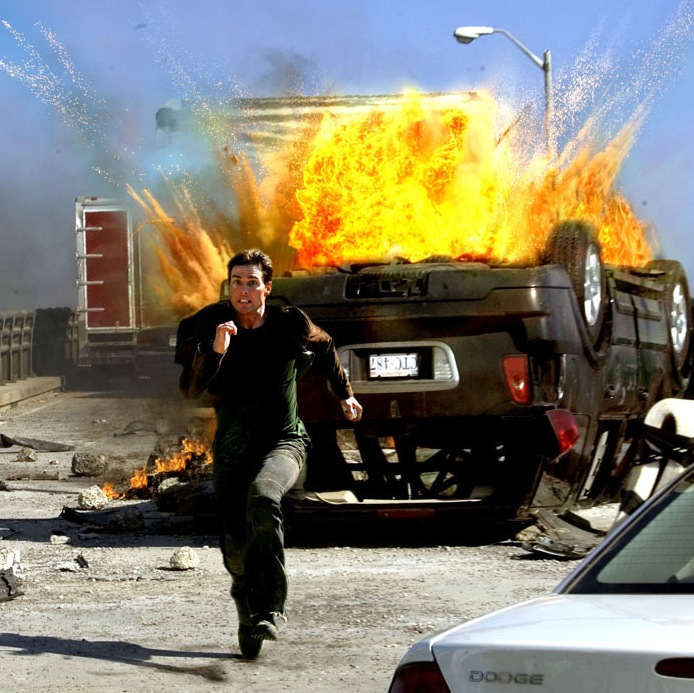
But back to Inception. DiCaprio is becoming a world-class movie star. He has the intensity and the ability to share vulnerability that Tom Cruise had before he became a Scientologist (see Cruise in the 80s, some 90s), when he decided to replace actual acting with, as my wife so aptly put it, running ("That's all he does now in his movies," Ai says of Cruise. "He just runs.") I don't blame DiCaprio for Inception's disappointments, far from. Like with The Departed he's proven here again that he's no longer a boy; he's finally figured out how to get his poster off pre-teen girls' bedroom walls. Ie. men now have respect for the guy. No, DiCaprio is not the issue. The fault here lies squarely with the director, with Nolan.
Inception looks amazing and may possibly give viewers the kind of thrill I remember getting seeing Terminator 2 for the first time in theatres, or, slightly more recently, The Matrix (whose dating himself now?). The problem with Inception is I felt no real sense of danger. I was not nearly as anxious or curious as to what the hell was going on watching Inception as I had been with Memento, was not nearly as gut-twistingly terrified at the same time as I was thrilled experiencing The Dark Knight. With Nolan's latest I just didn't care enough.
The film pivots on the importance of DiCaprio's character getting back home (to America) to symbolically let his dead wife go and see his kids. The problem, as David Denby in his New Yorker review of Inception so aptly put it, is that we never get to know these children in the slightest (only the image of the backs of their heads) so that we don't care about the kids, nor did I get any sense of DiCaprio as father. If a two and a half hour movie revolves around someone getting back to something the audience needs to have some semblance of reason why we should care for that something other than just a Kodak commercial's picture of it (or the back of the heads of it). Perhaps if Nolan had had the courage to cut fifteen minutes from his James Bond guns-on-ski-slopes action sequence to actually let us see DiCaprio as father... maybe then something might have resonated. Somehow, though, even that kind of quick fix flashback would have rang false, and I think I know why.
In The Dark Knight we had characters to terrify and beguile and trouble the mental stability out of us (Heath Ledger's Joker), and we also had characters to truly love for their integrity (Gary Oldman's Commissioner Gordon). What, on the other hand, do your remember about DiCaprio's wife in Inception other than that she was French and beautiful and had an unusual first name (Mal)? What of DiCaprio's character himself? He was intense and focused and driven, but I can't even remember his character's name let alone care about his pain.
What rang so hollow with Inception? Why did I walk away not caring about any of these people? Because I think that the entire premise, I think that the letting go of a dead wife and the getting back to see his children were merely devices to drive a plot about an idea (something to do with memory and dreams and dreams within dreams) that was never nearly as interesting as Nolan may have thought.
There are, to be sure, ideas movies where the premise is so astonishing that we can get over the ever-wooden ways of one Keanu Reeves, but as it turns out The Matrix Christopher Nolan's Inception is not.
Showing posts with label Inception. Show all posts
Thursday, July 29, 2010
Friday, July 16, 2010
MOVIE STUFF: "Inception," "2001," A.O. Scott and the Problem of the Blockbuster
My timing is terrible. I shouldn't have gone with Ai to see Stanley Kubrick's "2001: A Space Odyssey" on the big screen last night. Why? Cause Chris Nolan's (of the Dark Knight franchise) "Inception" comes out today and chances are I'll have seen it before I next post. Fact is I've been waiting months for a decent big budget flick to come to theatres and I am sure Inception will look great and feel great and make money in the bagazillions, and that better "Inception" than another Transformers sequel. Ie. it'll fit the bill perfectly. But what NY Times movie critic A.O. Scott (is there a better critic out there now?) has already confirmed in his review- what we all probably knew anyway -
is that, really, it's just gonna be a very cool, super slick, tale-twisting piece of fluff. Scott's piece suggests many critics out there are going a little overboard with their praise. Before continuing, let me remind you that I posted the trailer for "Inception" here not long ago - that's how excited I was and still basically am to see it.
Maybe right now you're saying, C'mon Jon, isn't that all we want from a summer movie? Fuck, would be my slightly irate reply. Is that all? Really? Ai has recommended I be less judgmental on my blog and usually I endeavour to follow her advice cause she's much brighter than I am. Perhaps this time, though, we need a little judgment. (Shit, where would morality come from if not for judgment?) Does every single Saturday night movie we go to have to be pure escape, total dumbed-down "Get Me To the Greek" dick and fart comedy? Does everything have to be "Sex and the City" fluffy? Should they just ship me off to France now to read long Russian 19th century novels? Maybe they should, though my Japanese, crap as it is, is still better than my pathetic French.
I'm beginning to feel progressively more unusual in this art-wanting obsession of mine, though the twenty-five or so other folks at the old Bloor cinema watching "2001" alongside my wife and I, folks who had the zitsfleisch to sit for two and a half hours and manage neither to talk or even once open their cell phones - they give me hope. A.O. Scott gives me hope. He longs for better pictures, wishing as he so gloriously does for a movie that could entertain and have the brains for more than just clever puzzles and beautiful set pieces. Maybe it could also have something to say?
Last night I watched a masterpiece, invited no one but my wife (that's not true; I invited one friend; he said no), secure in the knowledge that most people would rather not spend 141 minutes in an old theatre watching an at times preposterously slow and difficult movie.
Like a challenging novel, "2001" had me drifting off, which our educational and business minded system so chastises, and yet to me is the very fertile ground upon which original thought and creativity are born. My mind raced, I travelled back through memories, good and bad, thought of all the movies that could never have been without Kubrick's film. I thought of the rather indisputable theory that the summer blockbuster was born of two movies: Steven Spielberg's "Jaws" and George Lucas' "Star Wars." You need only watch the long middle third of "2001" to recognize that without Kubrick's 9th film there could have been no Millennium Falcon, no Luke Skywalker, no Death Star. "Star Wars" is "2001" for kids (of all ages), is all I kept thinking, Srauss' gorgeous music (both Richard and Johann's) booming out the old Bloor cinema's speakers. Lucas' conceit was unquestionably brilliant. Take the space show Kubrick constructed and so famously set to classic music in a way that had never been done before, dumb it down, make it easier, faster, more violent. In other words, more light sabers, less contemplation.
Thus, the first summer blockbusters: the big screen roller coasters we love.
I'm not saying there's anything wrong with roller coasters. I buy my tickets, believe me (hell, I even saw the new "Karate Kid" - and actually enjoyed it!), I wait in line with the rest and love how the wind ruffles my remaining hair, how my stomach will drop at the big dip, all that fast turning caramel corn fun stuff. Who doesn't like that? I just wonder why we don't occasionally ask for more?
"2001" makes you wonder about the meaning of the universe, of man [sic], and much, much more. "Inception," I fear (and A.O. Scott has all but already confirmed), will just be another thrill ride.
Movies are so much fun; it's just sometimes I wish they could be films.
Rant over and out.
[Click here for my review: The Problem With "Inception" ]
is that, really, it's just gonna be a very cool, super slick, tale-twisting piece of fluff. Scott's piece suggests many critics out there are going a little overboard with their praise. Before continuing, let me remind you that I posted the trailer for "Inception" here not long ago - that's how excited I was and still basically am to see it.Maybe right now you're saying, C'mon Jon, isn't that all we want from a summer movie? Fuck, would be my slightly irate reply. Is that all? Really? Ai has recommended I be less judgmental on my blog and usually I endeavour to follow her advice cause she's much brighter than I am. Perhaps this time, though, we need a little judgment. (Shit, where would morality come from if not for judgment?) Does every single Saturday night movie we go to have to be pure escape, total dumbed-down "Get Me To the Greek" dick and fart comedy? Does everything have to be "Sex and the City" fluffy? Should they just ship me off to France now to read long Russian 19th century novels? Maybe they should, though my Japanese, crap as it is, is still better than my pathetic French.
I'm beginning to feel progressively more unusual in this art-wanting obsession of mine, though the twenty-five or so other folks at the old Bloor cinema watching "2001" alongside my wife and I, folks who had the zitsfleisch to sit for two and a half hours and manage neither to talk or even once open their cell phones - they give me hope. A.O. Scott gives me hope. He longs for better pictures, wishing as he so gloriously does for a movie that could entertain and have the brains for more than just clever puzzles and beautiful set pieces. Maybe it could also have something to say?
Last night I watched a masterpiece, invited no one but my wife (that's not true; I invited one friend; he said no), secure in the knowledge that most people would rather not spend 141 minutes in an old theatre watching an at times preposterously slow and difficult movie.
Like a challenging novel, "2001" had me drifting off, which our educational and business minded system so chastises, and yet to me is the very fertile ground upon which original thought and creativity are born. My mind raced, I travelled back through memories, good and bad, thought of all the movies that could never have been without Kubrick's film. I thought of the rather indisputable theory that the summer blockbuster was born of two movies: Steven Spielberg's "Jaws" and George Lucas' "Star Wars." You need only watch the long middle third of "2001" to recognize that without Kubrick's 9th film there could have been no Millennium Falcon, no Luke Skywalker, no Death Star. "Star Wars" is "2001" for kids (of all ages), is all I kept thinking, Srauss' gorgeous music (both Richard and Johann's) booming out the old Bloor cinema's speakers. Lucas' conceit was unquestionably brilliant. Take the space show Kubrick constructed and so famously set to classic music in a way that had never been done before, dumb it down, make it easier, faster, more violent. In other words, more light sabers, less contemplation.
Thus, the first summer blockbusters: the big screen roller coasters we love.
I'm not saying there's anything wrong with roller coasters. I buy my tickets, believe me (hell, I even saw the new "Karate Kid" - and actually enjoyed it!), I wait in line with the rest and love how the wind ruffles my remaining hair, how my stomach will drop at the big dip, all that fast turning caramel corn fun stuff. Who doesn't like that? I just wonder why we don't occasionally ask for more?
"2001" makes you wonder about the meaning of the universe, of man [sic], and much, much more. "Inception," I fear (and A.O. Scott has all but already confirmed), will just be another thrill ride.
Movies are so much fun; it's just sometimes I wish they could be films.
Rant over and out.
[Click here for my review: The Problem With "Inception" ]
Labels:
2001,
Christopher Nolan,
Inception,
Movies,
Stanley Kubrick
Subscribe to:
Posts (Atom)


