Wanted to share with my blog readers that I have been hired by Chapters/Indigo (a big-box bookstore in Canada - where I spent the last six months working as a bookseller) to write for their website's fiction blog. Am doing a weekly piece, a sort of literary review with ever-changing themes. The first is on Japan. You can check it out here.
Onwards and upwards.
Tuesday, 31 May, 2011
Friday, 27 May, 2011
Best of PBIHT: Terence Malick's "The New World" (2005)
[Originally published in 2009]
[Re-publishing because I cannot wait for "The Tree of Life" to come out]
"The New World" is not for everyone
It's not fast-paced.
There are no transforming machines.
There are long stretches without dialogue.
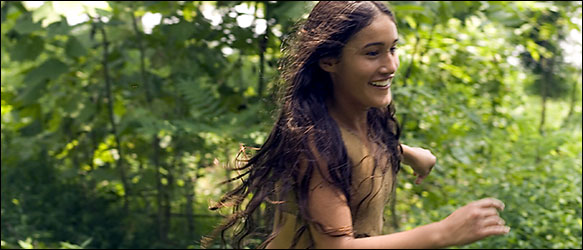
Terence Malick's 4th pic in over 30 years is a slow meditation of a story, as much atmosphere and image as story and it is filled with beautiful music and stunning visions of nature as it was in Virginia, America sometime in the 17th century (and which has a striking resemblance to the glory that is Algonquin Park in Ontario).
The story?
A modern take on the first white people to live in America, and their encounters with the Native Indians who already lived on the land. Modern because the white people aren't portrayed as angels.
The beauty?
Malick ("Badlands," "The Thin Red Line") is so assured in his filmmaking he is not afraid to take a minute (as in the full sixty seconds) and let camera linger, to let camera stop and fixate on the nature of water as it rolls on over a rock. Or to follow a paddling canoe up a river cutting between marshland, just the sounds of the paddles hitting water, the crickets in the marshes, the birds fluttering. Or the way he sets up a score of horns and symphony buildup to highlight the moment a few grand British ships and their powerful sails were sighted from a green forest shore between trees by the Indigenous people of that land, of America, and all the ominous tragedy of what was to come.
Need I say more?
Yes. Just the charm, spirit, wonder, wisdom and beauty of the girl they chose to call ...

...Pocahontas.
[Re-publishing because I cannot wait for "The Tree of Life" to come out]
"The New World" is not for everyone
It's not fast-paced.
There are no transforming machines.
There are long stretches without dialogue.
Terence Malick's 4th pic in over 30 years is a slow meditation of a story, as much atmosphere and image as story and it is filled with beautiful music and stunning visions of nature as it was in Virginia, America sometime in the 17th century (and which has a striking resemblance to the glory that is Algonquin Park in Ontario).
The story?
A modern take on the first white people to live in America, and their encounters with the Native Indians who already lived on the land. Modern because the white people aren't portrayed as angels.
The beauty?
Malick ("Badlands," "The Thin Red Line") is so assured in his filmmaking he is not afraid to take a minute (as in the full sixty seconds) and let camera linger, to let camera stop and fixate on the nature of water as it rolls on over a rock. Or to follow a paddling canoe up a river cutting between marshland, just the sounds of the paddles hitting water, the crickets in the marshes, the birds fluttering. Or the way he sets up a score of horns and symphony buildup to highlight the moment a few grand British ships and their powerful sails were sighted from a green forest shore between trees by the Indigenous people of that land, of America, and all the ominous tragedy of what was to come.
Need I say more?
Yes. Just the charm, spirit, wonder, wisdom and beauty of the girl they chose to call ...

...Pocahontas.
Labels:
Movies,
The New World
Tuesday, 24 May, 2011
Franco
I haven't come to terms with the fact that James Franco - a famous movie star whose star was on the ascent - volunteered himself to act on a soap opera (General Hospital - and as a crazy artist) never mind the book of short stories he published last year, the Oscar nomination, the PhD he's working on, the Masters he has just about completed, the film he just directed and the hosting (albeit abysmally, but still) of this year's Oscars.
And if it all seems like utter bullshit, or something very very phony, check out even a bit of his interview on charlierose.com (see recent shows: no link, sorry)- the guy is nothing if not interesting and original.
And if you ever wanted to be convinced of his chops as an actor check out the biopic where he played James Dean.
Thursday, 19 May, 2011
BEST OF PBIHT: The Buddhist Bus Ride - Part II
Continued from The Buddhist Bus Ride I
Originally posted November 2009
LIFE IS SUFFERING cont.
In truth, the ache would be a minor Tylenol treatable pfft kind of a thing were it not for the invention of the phone that is cellular, and the airtime that is unlimited or far too cheap. (Cause if you just upped the airtime prices it would force people to text - and quiet clicking away on a cell phone is the only civil cell phone activity that should be permitted on a bus, if you ask the aging and increasingly curmudgeon that is me.)
To spiral one down to the darkest circle of the inferno, it just takes one, one loud-talking, phone nuzzling shmo. You know the one, who so conveniently and even disturbingly sincerely manages not to consider that there might be about 57 other passengers on the bus not interested in a one-sided conversation where the other person (the one you can't hear) is always speaking so softly that the cell phone bus passenger has
no choice, of course, but to start yelling, 'WHAT? WHAT? I CAN'T HEAR YOU?'
SEEING IS BELIEVING
According to one famous Christian saying, "It is easier for a camel to go through the eye of a needle than for a rich person to enter heaven." As per my limited experience with camels (one experience - not comfortable - because male) and kingdoms of God (no experiences - some discomfort - because mortal), I can't, in good conscience, confirm or deny this. I can say, though, that the rich can have beautiful babies. They also can have revelations.
The young and profoundly sheltered prince who would one day be Buddha had a revelation that came as a result of seeing a crippled old man in his court. The Buddha's father, the king, had tried to keep all bad things from his son's view. All disease, all aging sadness - he tried to protect his son from the dark, ugly side of the world. It was an accident then (or perhaps the Prince had left his court... I can't remember which) that the Prince saw this crippled, hobbling old man so close to death.
Upon seeing him, the prince realized that one day this old man would be him. From this, the revelation that would send the prince from his castle, to leave behind his riches:
We all grow old and die.
At its very core, then, the first of The Fourfold Noble Truths from "The Teaching of Buddha" begins:
The world is full of suffering. Birth is suffering, old age is suffering, sickness and death are sufferings. To meet a man whom one hates is suffering, to be separated from a beloved one is suffering, to be vainly struggling to satisfy one's needs is suffering...
The angry jerking manner in which most Toronto TTC bus drivers handle their buses is suffering. The callous manner in which they take off, lurching forward from stop before that elderly woman has taken her seat is suffering. The odd way in which we've all chosen to live in progressively busier and busier anthills is suffering.
This all begs the question, how does knowing of the pain, the suffering, help? What's the wisdom in that?
WHAT IF WE CAN'T
Originally posted November 2009
LIFE IS SUFFERING cont.
In truth, the ache would be a minor Tylenol treatable pfft kind of a thing were it not for the invention of the phone that is cellular, and the airtime that is unlimited or far too cheap. (Cause if you just upped the airtime prices it would force people to text - and quiet clicking away on a cell phone is the only civil cell phone activity that should be permitted on a bus, if you ask the aging and increasingly curmudgeon that is me.)
To spiral one down to the darkest circle of the inferno, it just takes one, one loud-talking, phone nuzzling shmo. You know the one, who so conveniently and even disturbingly sincerely manages not to consider that there might be about 57 other passengers on the bus not interested in a one-sided conversation where the other person (the one you can't hear) is always speaking so softly that the cell phone bus passenger has
no choice, of course, but to start yelling, 'WHAT? WHAT? I CAN'T HEAR YOU?' SEEING IS BELIEVING
According to one famous Christian saying, "It is easier for a camel to go through the eye of a needle than for a rich person to enter heaven." As per my limited experience with camels (one experience - not comfortable - because male) and kingdoms of God (no experiences - some discomfort - because mortal), I can't, in good conscience, confirm or deny this. I can say, though, that the rich can have beautiful babies. They also can have revelations.
The young and profoundly sheltered prince who would one day be Buddha had a revelation that came as a result of seeing a crippled old man in his court. The Buddha's father, the king, had tried to keep all bad things from his son's view. All disease, all aging sadness - he tried to protect his son from the dark, ugly side of the world. It was an accident then (or perhaps the Prince had left his court... I can't remember which) that the Prince saw this crippled, hobbling old man so close to death.
Upon seeing him, the prince realized that one day this old man would be him. From this, the revelation that would send the prince from his castle, to leave behind his riches:
We all grow old and die.
At its very core, then, the first of The Fourfold Noble Truths from "The Teaching of Buddha" begins:
The world is full of suffering. Birth is suffering, old age is suffering, sickness and death are sufferings. To meet a man whom one hates is suffering, to be separated from a beloved one is suffering, to be vainly struggling to satisfy one's needs is suffering...
The angry jerking manner in which most Toronto TTC bus drivers handle their buses is suffering. The callous manner in which they take off, lurching forward from stop before that elderly woman has taken her seat is suffering. The odd way in which we've all chosen to live in progressively busier and busier anthills is suffering.
This all begs the question, how does knowing of the pain, the suffering, help? What's the wisdom in that?
TRUER THAN TRUTH
"There is an old Jewish saying that I love," Isabelle Allende, the Chilean-American, says, opening her moving but also hilarious Ted talk called Tales of Passion. "What is truer than truth? Answer: The Story."
Well this Jewish-Canadian cannot conceive of a better way to approach even the most surface of understandings of Buddhist wisdom than with a parable.
It is ancient times and a mother has suffered the greatest tragedy a mother can - the loss of her child. In agony she pleads with the Buddha to do something. He contrives of a way to help her, saying that if she can procure one particular spice (he names a spice common to most any kitchen) from any home upon which death has not touched its door, then he can bring her child back to life.
The woman visits home upon home and of course, in every case, she learns that all the families have been touched by death. All have lost mothers, husbands, children.
At the story's end, the woman does not - cannot - get her child back of course - that is impossible. Instead, what the Buddha has taught her, what she has learned, is that she is not alone in her pain.
WHAT IF WE CAN'T
Whether we are dealing with the most horrific of human tragedy, or the most mundane of daily struggle, there is a Disney danger, I think, in always trying to escape our fates, our pains, our realities. Yet so much of the modern western lifestyle does exactly this. Buddhism suggests the opposite because we cannot cheat death, and sometimes, when the walk would just be too long, or a bike ride just not possible because it's frigid February, sometimes we can't get off the bus.
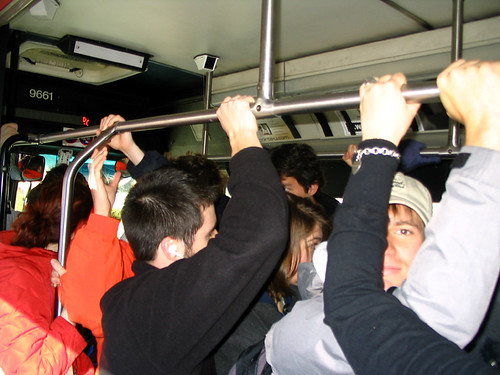
Which brings us to the impetus for this overlong series of posts. Some advice the Dalai Lama once gave of how to deal when in a crowded, uncomfortable situation, eg. a crowded bus. He recommended to look around, to actually see the people around you. You ever do that? Look at all the other sad souls on that bus, the misery plastered on their faces? You ever recognize that the misery on your face is the misery on everyone's face? That you are not alone in your misery is, however, only the first part.
The 14th Dalai Lama, who speaks of compassion above all else as the ultimate good, takes the advice a critical step further. What he has taught me to do on that bus, and only when I remember - and oh how easily we forget - is to step out from my own misery and not just look to the misery of those passengers around me, but to empathize with them and offer of my compassion in response. Offer of your kindness to relieve their pain.
Now let's be clear, out of ten bus rides I doubt I'm batting .200, but when I do step out from me and empathize with you, I no longer feel miserable.
WHAT CHOICE DO WE HAVE
I'm sure you'll agree that there are but two types of old men in the world: the grumpy old man and the sweet, gentle old man. And the same way all men believe they are Michael when they watch "The Godfather" because, as my brother-in-law, Roberto, so astutely once put it, "Nobody thinks they're Fredo," no one believes that they will grow up to be the grumpy old man either.
And yet, with each passing year I became more the old man wanting to snip and bark at dumb teenagers who yell on buses and throw garbage out windows, that aging man I am who seethes at how much worse the world has gotten, hell in the old hand basket... But when I can remember, I lately find myself voicing in my head that mind-altering Ghandi quote:
"Be the change you want to see in the world."
We assume this to mean ending global warming or AIDS in Africa, and God bless. But it can heal small too. When I remember to be compassionate for the crap a bus driver deals with or the suffering of my fellow commuters, I like to think I inch that much closer to the sweet, gentle old man and suffer that much less. I'm not suggesting Nirvana, just feeling a bit happier.
End
Tuesday, 17 May, 2011
BEST OF PBIHT: A Buddhist Bus Ride - Pt I
[Originally posted November 2009]
No one longs to be a cliche. They don't fly to Japan planning to be yet another white guy who brings back a Japanese bride. They don't fly to Japan with the intent of going Zen, never mind espousing theories of Buddhism.
But they do. They do it all. Marry the Japanese girl, sleepover at a Buddhist mountain top with all the other white tourists. Books by the Dalai Lama become toilet readings. Attempts at meditation become commonplace. (These aren't attempted on or near a toilet.) The very act of sitting at dinner or desk a little more straight-backed rings spiritual in their Western heads.
The world, though, is of course getting smaller. The East now dreams as Hollywood West prescribes, while the West rushes with their Japanese wife to a yoga class every Thursday night at the local community centre (it feels sooo good after).
East or West, what interests us, however, what we aspire to, is not who we are in the now (unless your surname is Lama). Otherwise, duh, we'd already be there.
No, in the now we can be really fucking annoyed, and sometimes overwhelmingly mad especially when on a long and crowded bus.
LIFE IS SUFFERING
The Buddha, even before he was the Buddha, never took the bus. For one, his was a time before buses; and two, he was originally a prince, ie. rich, therefore above bus taking.
Ergo the rich need not read this post. They don't know from buses. Shit, the middle class barely stray beyond a subway in Toronto unless they absolutely have to. No, the moneyed don't know from this pain (I'm assured they have other pains to deal with). For all the rest who regularly take buses, you know that buses have gotten busier, traffic angrier. You know the urban expanding reasons. You know also from where I ache - eg. the very depths of my soul.
The ache I regularly take is a busy and lengthy bus ride, much of it filled with the headphone-leaked ootza-ootza (as my friend Sonia puts it), techno music beats, and the never quiet conversation treats of the teen-aged. There's everyone's favourite, the elbow jostle for a bit of 'do you mind if I actually sit back in my seat' room. There's the supreme misfortune of being stuck in a middle seat between men, when the whole ride is a knee wrestle for territory, like dogs pissing, but with knees. (Being of the gender, I'll 'man up' and admit my knees, both the right and the left, have more than likely been the cause of not a few others' misery, tuck in my legs as I think I might.) This just to name a couple instigators of the pain, and these only if you're lucky enough to snag a seat.
The Ride Continues Thursday.
No one longs to be a cliche. They don't fly to Japan planning to be yet another white guy who brings back a Japanese bride. They don't fly to Japan with the intent of going Zen, never mind espousing theories of Buddhism.

But they do. They do it all. Marry the Japanese girl, sleepover at a Buddhist mountain top with all the other white tourists. Books by the Dalai Lama become toilet readings. Attempts at meditation become commonplace. (These aren't attempted on or near a toilet.) The very act of sitting at dinner or desk a little more straight-backed rings spiritual in their Western heads.
The world, though, is of course getting smaller. The East now dreams as Hollywood West prescribes, while the West rushes with their Japanese wife to a yoga class every Thursday night at the local community centre (it feels sooo good after).
East or West, what interests us, however, what we aspire to, is not who we are in the now (unless your surname is Lama). Otherwise, duh, we'd already be there.
No, in the now we can be really fucking annoyed, and sometimes overwhelmingly mad especially when on a long and crowded bus.
LIFE IS SUFFERING
The Buddha, even before he was the Buddha, never took the bus. For one, his was a time before buses; and two, he was originally a prince, ie. rich, therefore above bus taking.
Ergo the rich need not read this post. They don't know from buses. Shit, the middle class barely stray beyond a subway in Toronto unless they absolutely have to. No, the moneyed don't know from this pain (I'm assured they have other pains to deal with). For all the rest who regularly take buses, you know that buses have gotten busier, traffic angrier. You know the urban expanding reasons. You know also from where I ache - eg. the very depths of my soul.

The ache I regularly take is a busy and lengthy bus ride, much of it filled with the headphone-leaked ootza-ootza (as my friend Sonia puts it), techno music beats, and the never quiet conversation treats of the teen-aged. There's everyone's favourite, the elbow jostle for a bit of 'do you mind if I actually sit back in my seat' room. There's the supreme misfortune of being stuck in a middle seat between men, when the whole ride is a knee wrestle for territory, like dogs pissing, but with knees. (Being of the gender, I'll 'man up' and admit my knees, both the right and the left, have more than likely been the cause of not a few others' misery, tuck in my legs as I think I might.) This just to name a couple instigators of the pain, and these only if you're lucky enough to snag a seat.
The Ride Continues Thursday.
Labels:
Buddhist Bus Rides,
Japan
Sunday, 15 May, 2011
Monday, 9 May, 2011
Letter to Tom Cruise
So I'm watching one of these actor's roundtables of Oscar nominated super stars where the best of the best, the Cate Blanchetts and the Leonardo DiCaprios are asked about their craft, and I get to thinking about Tom Cruise. I think of Tom because of Brad Pitt, cause he's invited to these roundtables. Brad's invited cause he's getting nominated for oscars these days. Gets me thinking back to a time not that long ago when Tom and a young Brad Pitt seemed to be neck-and-neck fighting to be the pretty, most popular boy in Hollywood.
The game long since lost, Tom stuck on pretty, Brad fighting valiantly to be that much more - and thus has become - I think to myself, poor Tom Cruise. I'm gonna write the guy a letter. That should help.
Dear Tom Cruise,
You must watch Brad and DiCaprio and all these other handsome blokes that are now not just boat lengths but oceans ahead of you, and you must wonder why? Why why why? I was great in "Top Gun," I was something in "The Colour of Money," shit I even gained indie cred when I did "Magnolia;" so where's my oscar nod? Where's my love? Why don't they want to hear me talk about my process and my choices.
Well the answer, Mr. Cruise, is simple: you need simply quit that cult-like religion of yours. Quit bloody Scientology, Tom! I don't know, nor do I much care, if you're gay, but man, whatever it is, that cult of yours has gotten you to hide every aspect of your personality (assuming you still got one). You want to be an actor we care even a little about again? Then start doing the things great actors are paid to do. Yes, for Hollywood you gotta look good and eat right, and exercise obsessively, and you got that stuff down pat, but if you want some more of that Oscar stuff, you also gotta bare something resembling a soul, be a little vulnerable and brave the way you actually were when you were a good actor in the 80s. Do that and we may actually care about your performances again. Otherwise, you be going the way of the dodo bird.
Them's the harsh truths.
Best,
JM
PS This letter might be coming to you about a decade too late, but still ...
The game long since lost, Tom stuck on pretty, Brad fighting valiantly to be that much more - and thus has become - I think to myself, poor Tom Cruise. I'm gonna write the guy a letter. That should help.
Dear Tom Cruise,
You must watch Brad and DiCaprio and all these other handsome blokes that are now not just boat lengths but oceans ahead of you, and you must wonder why? Why why why? I was great in "Top Gun," I was something in "The Colour of Money," shit I even gained indie cred when I did "Magnolia;" so where's my oscar nod? Where's my love? Why don't they want to hear me talk about my process and my choices.
Well the answer, Mr. Cruise, is simple: you need simply quit that cult-like religion of yours. Quit bloody Scientology, Tom! I don't know, nor do I much care, if you're gay, but man, whatever it is, that cult of yours has gotten you to hide every aspect of your personality (assuming you still got one). You want to be an actor we care even a little about again? Then start doing the things great actors are paid to do. Yes, for Hollywood you gotta look good and eat right, and exercise obsessively, and you got that stuff down pat, but if you want some more of that Oscar stuff, you also gotta bare something resembling a soul, be a little vulnerable and brave the way you actually were when you were a good actor in the 80s. Do that and we may actually care about your performances again. Otherwise, you be going the way of the dodo bird.
Them's the harsh truths.
Best,
JM
PS This letter might be coming to you about a decade too late, but still ...
Thursday, 5 May, 2011
BEST OF PBIHT: Tokyo Tomato - Part III
continued from Tokyo Tomato Part II

The Oak Door. To my left the dim lit restaurant. High ceilings, wide chairs. Straight ahead there was an on open kitchen where you could watch an international staff fire up your obscenely priced slab of beef.
To my right was the bar area, where the two hostesses, like "Catch Me If You Can" flight attendants from a different era (or rather like Japanese flight attendants of this era, female, stunningly beautiful, perfectly polite, slightly disturbingly too perfect), quickly led me, still very much in my hiking shoes. I'd told them why I was there, who I was there to meet. Still they moved me quickly away from the entrance.
I tried to hide my knapsack by my stool and quickly took out my pen and notebook, as if these were a kind of proof. A bartender asked if I wanted anything. I looked at the prices, said I was OK. The bartender ignored me after that
and went on mixing drinks for actual customers, stirring in expert fashion, rapid yet soft upward motions - maximum mixability, zero spillage.
When Franz finally came he looked all the more official wearing the tall, white chef’s hat to match his coat. He wasn’t unfriendly but he didn’t sit. It worried me that he didn’t. It worried me more when he asked me who I was and what my credentials were. Had I even contacted the hotel’s PR people? Franz asked, realizing that if I was indeed any sort of professional writer I’d have known that was the place to start. Did I know, he said, that he couldn’t say much unless I went through the proper channels? I understood completely. I was a fake. He was a busy man. ‘If you could kindly leave the restaurant, sir, that would be much appreciated’, would come next. Except that it didn’t. He didn’t chill to my inexperience or throw me out of the bar. Instead he asked what I’d like to drink.
To drink? Mojito flashed through my mind. Then it was scotch, scotch, scotch like a ticker tape across my brain. But he was such a nice guy. I felt a bastard trying to weasel my way into fancy free drinks that cost upwards of $15. So I said beer. (It cost $10.)
And I wasn’t a total bastard. I really did love great food and great hotels. I had the notebook because there had always been the writer dream and maybe he saw that in me, and maybe he was just a hell of a nice guy helping a kid who was closer to thirty than twenty but still had no idea what he was doing or how he was going to get there.
I started to ask about how he got his start, how he had made it so far, where he came from. I scribbled like crazy trying to keep up. There wasn’t any order to my questions nor did they add up to anything but Franz didn’t seem to mind. I figured it best to let him control the direction of the conversation. He got to talking about the quality of the ingredients inJapan , the best he’d ever worked with. The fish, of course, was first-rate, but also the meat, the tomatoes. He saw the disbelief on my face. The supermarket tomatoes I knew back in Osaka were disturbingly perfect looking and utterly flavourless.
Had I ever had a tomato fromKumamoto , he asked me.
Had I?! I had not.
Franz turned to look for a waiter. One surfaced out of thin air the way they are trained to do in five-star establishments. Soon I had a tomato, halved, on a plate in front of me, shaved Daikon radish piled unobtrusively - gently - off to the side. “Bring some salt,” Franz told the waiter, managing not to sound the least bit rude though he hadn’t said please.
The salt, of the pebbly rock variety, was served in a silver dish. Beside my glass ofKirin a slice of sourdough bread and a square of butter had been placed down so gently I hadn’t even noticed them at first.
The tomato was a deep, sincere red. I sprinkled some salt pebbles on each half, and knife and forked a bite. Usually one to talk before thinking – or rather one to talk as a form of thinking – I was careful this time to select a phrase that would accurately express to the executive head chef of all seven of the Tokyo Grand Hyatt’s restaurants the effect this tomato had on me.
"Oh my God, Franz.”
He wasn’t much phased, though. And he was sorry but he had to go. Other restaurants to check on. Before leaving, Franz told me to make sure to contact PR and that once I got permission from them I could have free reign of the hotel and a real interview. I said I would. I thanked him a lot, then took his hand to say it again with all I could shake.
I stayed a good half hour longer, nursing my beer, trying to make it all last. I was in what is said to be the best steakhouse inTokyo but I wouldn’t know, not on a teacher’s salary. It really didn’t matter. Because for that moment, with tomato, Kirin and a slice of sour dough bread, I was all the glitter and glamour you could wish for. This was my 1947 glass of Macallan. This was my escape, my recharge, what I needed to continue.
I feel compelled to tell you I did go back down to the Maduro, to the jazz bar, later that night. I had to pay for my drink.

The Oak Door. To my left the dim lit restaurant. High ceilings, wide chairs. Straight ahead there was an on open kitchen where you could watch an international staff fire up your obscenely priced slab of beef.
To my right was the bar area, where the two hostesses, like "Catch Me If You Can" flight attendants from a different era (or rather like Japanese flight attendants of this era, female, stunningly beautiful, perfectly polite, slightly disturbingly too perfect), quickly led me, still very much in my hiking shoes. I'd told them why I was there, who I was there to meet. Still they moved me quickly away from the entrance. I tried to hide my knapsack by my stool and quickly took out my pen and notebook, as if these were a kind of proof. A bartender asked if I wanted anything. I looked at the prices, said I was OK. The bartender ignored me after that
and went on mixing drinks for actual customers, stirring in expert fashion, rapid yet soft upward motions - maximum mixability, zero spillage. When Franz finally came he looked all the more official wearing the tall, white chef’s hat to match his coat. He wasn’t unfriendly but he didn’t sit. It worried me that he didn’t. It worried me more when he asked me who I was and what my credentials were. Had I even contacted the hotel’s PR people? Franz asked, realizing that if I was indeed any sort of professional writer I’d have known that was the place to start. Did I know, he said, that he couldn’t say much unless I went through the proper channels? I understood completely. I was a fake. He was a busy man. ‘If you could kindly leave the restaurant, sir, that would be much appreciated’, would come next. Except that it didn’t. He didn’t chill to my inexperience or throw me out of the bar. Instead he asked what I’d like to drink.
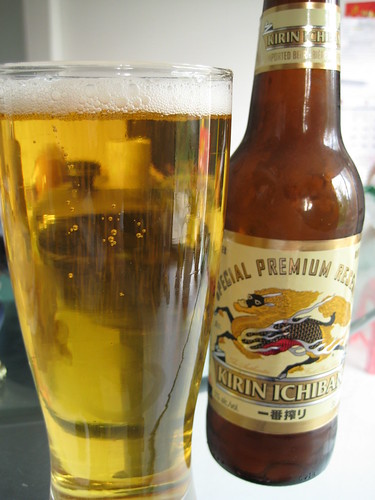
To drink? Mojito flashed through my mind. Then it was scotch, scotch, scotch like a ticker tape across my brain. But he was such a nice guy. I felt a bastard trying to weasel my way into fancy free drinks that cost upwards of $15. So I said beer. (It cost $10.)

And I wasn’t a total bastard. I really did love great food and great hotels. I had the notebook because there had always been the writer dream and maybe he saw that in me, and maybe he was just a hell of a nice guy helping a kid who was closer to thirty than twenty but still had no idea what he was doing or how he was going to get there.
I started to ask about how he got his start, how he had made it so far, where he came from. I scribbled like crazy trying to keep up. There wasn’t any order to my questions nor did they add up to anything but Franz didn’t seem to mind. I figured it best to let him control the direction of the conversation. He got to talking about the quality of the ingredients in
Had I ever had a tomato from
Had I?! I had not.
Franz turned to look for a waiter. One surfaced out of thin air the way they are trained to do in five-star establishments. Soon I had a tomato, halved, on a plate in front of me, shaved Daikon radish piled unobtrusively - gently - off to the side. “Bring some salt,” Franz told the waiter, managing not to sound the least bit rude though he hadn’t said please.
The salt, of the pebbly rock variety, was served in a silver dish. Beside my glass of
The tomato was a deep, sincere red. I sprinkled some salt pebbles on each half, and knife and forked a bite. Usually one to talk before thinking – or rather one to talk as a form of thinking – I was careful this time to select a phrase that would accurately express to the executive head chef of all seven of the Tokyo Grand Hyatt’s restaurants the effect this tomato had on me.
"Oh my God, Franz.”
He wasn’t much phased, though. And he was sorry but he had to go. Other restaurants to check on. Before leaving, Franz told me to make sure to contact PR and that once I got permission from them I could have free reign of the hotel and a real interview. I said I would. I thanked him a lot, then took his hand to say it again with all I could shake.
I stayed a good half hour longer, nursing my beer, trying to make it all last. I was in what is said to be the best steakhouse in
I feel compelled to tell you I did go back down to the Maduro, to the jazz bar, later that night. I had to pay for my drink.
Monday, 2 May, 2011
BEST OF PBIHT: Tokyo Tomato Part II
Continued from Part I
Entering Maduro
I think the hotel receptionist phoned up to the jazz bar, called Maduro, because she didn’t quite catch my English, or lack of credentials. I was welcome, she smiled, if plastically, to go up to the fourth floor and take a look, though the bar wouldn’t open for another hour.

The elevator opened onto a wide sidewalk-like path, which ended at what I could only assume was the bar's entrance, a tall, heavy slab of polished tan wood set into the far end of an otherwise purely grey concrete structure. With no handle to pull or indication of where to push, I was much relieved when as I took the final steps toward it, the big hunk of wood slid effortlessly aside.
I found myself - the door quickly sliding closed behind me - in a dim, narrow passage. On the counter to my right, where I imagined the hostess would greet customers, was an old-fashioned desk lamp with green shade. There was a black curtain to my left blocking my view of most of the bar. I could see a sliver of it ahead, though, some plushy maroon chair backs, the small not lit stage beyond, a drum kit. There was the distant sound of a vacuum come on then suddenly turn off. I may have gotten a shiver. The darkened empty bar evoked Stanley Kubrick anxieties and I was just about to call out, somewhat Shelly Duvall shrilly,
for someone when the manager, or probably the assistant manager, emerged so spookily, but somehow not threateningly, out of nowhere it was less like “The Shining” and more like a cartoonish villain from a Scooby Doo cartoon.
The short, thin man in his fitted black suit didn’t - how shall I put this? - seem to have participated in a great deal of love-making he was so stiff-backed. He barely even attempted to fake an awful smile, not missing the quality of my outfit, my hiking shoes. He waited for me to speak. I was a journalist, I explained. This was somehow less impressive to him than I may have hoped. I scrambled to think up some questions.
All I learned from this uptight little man was that the band went on at nine. I’d be coming back to see them, I explained. He pursed his lips, nodded. Did they have any discounts for journalists, special prices on drinks maybe? Did he know? He nodded. He was sorry. No.
At The Altar of the Single Malt
I couldn’t have just left at that point. That would have been obvious. (Because thus far I had been sooo successful at fooling the man.) I asked if I could look round the bar.
He let me too, but only, I think, because it wouldn’t cost him anything. I pulled notebook from knapsack, clicked on my 105 yen pen and slow-walked around the windowless room jotting notes. I did this for as long as I thought I could
get away with it – five, six minutes.
I’ve since learned it’s damn near impossible to get a free lunch in Japan. In a land that is downright German in its love of uniforms and rules, I had yet to encounter a movie theatre usher who’d just let me in for free, no matter what the complaint or how subtle the charm. Where bureaucracy reigns supreme, there is little space for charisma (or a blatant disregard for the rules, for that matter).
Before leaving Maduro I went up to the bar. Approaching it reminded me of the feeling one gets walking up the centre aisle of St. Peter’s Basilica in Rome – a not dissimilar awe-inspiring experience. Of course, instead of Jesus and cross you got single malt scotches lined up in neat rows. There were also four giant champagne flute-like thingys hung high above, flames burning in each. Blocking most of a giant mirror behind the bar was a plant the size of a small tree. I nearly missed the bartender quietly working away amongst the grandeur. He seemed willing to answer a few questions. The Mojito was their most popular drink, a glass of 1947 Macallan was the most expensive at $420 a glass.
I was just about to go when a large Caucasian man entered the room wearing the kind of dirtied three-quarter length white coat that suggested he had either just come out of surgery or else he worked in a kitchen. I approached him because of his warm smile. His name was Franz. He was the executive head chef in charge of all five of the hotel’s restaurants. He was, with the soft (brown) eyes and confident belly of a good father, glad to talk to me. But could I come back a little later?
At 6:30 I was to meet him at The Oak Door, the hotel’s steak restaurant.
The final chapter in the tomato saga drops Thursday, in which a Japanese tomato has a more than likely chance of making an appearance.
Entering Maduro
I think the hotel receptionist phoned up to the jazz bar, called Maduro, because she didn’t quite catch my English, or lack of credentials. I was welcome, she smiled, if plastically, to go up to the fourth floor and take a look, though the bar wouldn’t open for another hour.
The elevator opened onto a wide sidewalk-like path, which ended at what I could only assume was the bar's entrance, a tall, heavy slab of polished tan wood set into the far end of an otherwise purely grey concrete structure. With no handle to pull or indication of where to push, I was much relieved when as I took the final steps toward it, the big hunk of wood slid effortlessly aside.
I found myself - the door quickly sliding closed behind me - in a dim, narrow passage. On the counter to my right, where I imagined the hostess would greet customers, was an old-fashioned desk lamp with green shade. There was a black curtain to my left blocking my view of most of the bar. I could see a sliver of it ahead, though, some plushy maroon chair backs, the small not lit stage beyond, a drum kit. There was the distant sound of a vacuum come on then suddenly turn off. I may have gotten a shiver. The darkened empty bar evoked Stanley Kubrick anxieties and I was just about to call out, somewhat Shelly Duvall shrilly,
for someone when the manager, or probably the assistant manager, emerged so spookily, but somehow not threateningly, out of nowhere it was less like “The Shining” and more like a cartoonish villain from a Scooby Doo cartoon. The short, thin man in his fitted black suit didn’t - how shall I put this? - seem to have participated in a great deal of love-making he was so stiff-backed. He barely even attempted to fake an awful smile, not missing the quality of my outfit, my hiking shoes. He waited for me to speak. I was a journalist, I explained. This was somehow less impressive to him than I may have hoped. I scrambled to think up some questions.
All I learned from this uptight little man was that the band went on at nine. I’d be coming back to see them, I explained. He pursed his lips, nodded. Did they have any discounts for journalists, special prices on drinks maybe? Did he know? He nodded. He was sorry. No.
At The Altar of the Single Malt
I couldn’t have just left at that point. That would have been obvious. (Because thus far I had been sooo successful at fooling the man.) I asked if I could look round the bar.
He let me too, but only, I think, because it wouldn’t cost him anything. I pulled notebook from knapsack, clicked on my 105 yen pen and slow-walked around the windowless room jotting notes. I did this for as long as I thought I could
get away with it – five, six minutes.
I’ve since learned it’s damn near impossible to get a free lunch in Japan. In a land that is downright German in its love of uniforms and rules, I had yet to encounter a movie theatre usher who’d just let me in for free, no matter what the complaint or how subtle the charm. Where bureaucracy reigns supreme, there is little space for charisma (or a blatant disregard for the rules, for that matter).
Before leaving Maduro I went up to the bar. Approaching it reminded me of the feeling one gets walking up the centre aisle of St. Peter’s Basilica in Rome – a not dissimilar awe-inspiring experience. Of course, instead of Jesus and cross you got single malt scotches lined up in neat rows. There were also four giant champagne flute-like thingys hung high above, flames burning in each. Blocking most of a giant mirror behind the bar was a plant the size of a small tree. I nearly missed the bartender quietly working away amongst the grandeur. He seemed willing to answer a few questions. The Mojito was their most popular drink, a glass of 1947 Macallan was the most expensive at $420 a glass.
I was just about to go when a large Caucasian man entered the room wearing the kind of dirtied three-quarter length white coat that suggested he had either just come out of surgery or else he worked in a kitchen. I approached him because of his warm smile. His name was Franz. He was the executive head chef in charge of all five of the hotel’s restaurants. He was, with the soft (brown) eyes and confident belly of a good father, glad to talk to me. But could I come back a little later?
At 6:30 I was to meet him at The Oak Door, the hotel’s steak restaurant.
The final chapter in the tomato saga drops Thursday, in which a Japanese tomato has a more than likely chance of making an appearance.
Labels:
Japan,
Short Story,
Tokyo Tomato
Subscribe to:
Posts (Atom)