Sunday, May 30, 2010

This Week's "Music To Read By" Soundtrack

SAD BASTARD MUSIC
(At least, the first 10 songs on my playlist are, with Miles' "Flamenco Sketches" getting a repeat because it's just that good.)

A little mellow background while you read, surf or play solitaire. Some newish stuff (Bon Iver, Yo La Tengo) and some not so new, -ish or otherwise  (Paul Simon, Cat Stevens).

As always, the soundtrack is optional. Cause my sad sap songs are certainly not for everyone.

Friday, May 28, 2010

Book Recommendation: Malcolm Gladwell's "What the Dog Saw"

Malcolm Gladwell, a staff writer at The New Yorker, is interested in success (and failure), of individuals, of organizations, of ketchup. Gladwell, who in his previous bestselling book, Outliers, made the 10,000 hour rule famous (a theory I was so taken with as to make it the heart of a lecture I give at the university where I teach), is the reason I started subscribing to The New Yorker.

His most recent book, What the Dog Saw, is a collection of his best New Yorker articles
dating back to 1996.

I was 18 the first time I really became aware of The New Yorker. I was deep into what seemed at the time the most important romantic relationship of my life (it lasted 3 months); the girl's father subscribed to the magazine. He kept stacks in one of the suburban house's bathrooms, the basement bathroom, I think. I didn't like it. The magazine, I mean. The bathroom was fine. But The New Yorker bothered me. It bothered me because it intimidated me. The cartoons didn't make immediate Jughead sense (I am visually stunted, though, to say the least), but also to open a New Yorker - it was so dense and pompous. Screw that, I thought.

Cut to a few years after my middle sister married a truly voracious reader and New Yorker subscriber, and he started passing his read issues onto me. The article that sold me on the magazine was published six years ago. There were articles before, of course. Adam Gopnik's 2002 piece about his daughter's imaginary friend, "Bumping Into Mr. Ravioli" was a definite classic, but it wasn't till 2004's Malcolm Gladwell piece, "The Ketchup Conundrum: Mustard Now Comes in Dozens of Varieties. Why Has Ketchup Stayed the Same?" that I knew I had to subscribe to this magazine. The New Yorker was supposed to be all pretentious puffery about MOMA curators and underwater basket weavers (albeit of the highest calibre) and here was an article about what made Heinz so friggin good.

"The Ketchup Conundrum" provides a history of ketchup (and mustard - the genius marketing that increased Grey Poupon's sales exponentially came from those famous commericals; you remember: "Pardon me, would you have any Grey Poupon?"). The article explains, amongst other things, that to make a Heinz-worthy ketchup is in fact extremely difficult. It has to do with the consistency of the tomatoes, when to pick them, how much sun they need, etc...

If you've read Outliers, The Tipping Point or Blink you know Gladwell's remarkable ability to make statisitics and theory anecdotal. As he's said himself, he takes the work that academics research and makes it palatable for the rest of us. He does that with story. Milk and cookies time, as my friend Roy says it. We all love hearing a good story by the fire, and Gladwell knows this. Like that best professor you may never have had. Smart as Einstein, storytelling gifted as Spielberg. OK, I'm getting excited here. But you get my meaning.And Gladwell's books are well displayed in every airport bookstore for good reason.

There's nothing new under the sun, according to the old testament. Newness or uniqueness is so often a simple combining of seemingly disparate variables. Gladwell is a master at this. Take the piece, "Most Likely to Succeed," where he parallels the school system's nearly impossible task of selecting and knowing which new teachers will actually be good teachers with the equally unpredictable task the National Football League has of drafting quarterbacks, the one position in the game, as it turns out, that the draft most often gets wrong.

I recommend What the Dog Saw because I think Gladwell, a journalist of over 30 years, is an even better writer in magazine sized pieces than he is in his longer form books. As New Yorker articles are about triple the length of say a Time magazine piece, they are long enough for him to delve deep into a topic like
"The Art of Failure: Why Some People Choke and Others Panic" or "The Talent Myth: Are Smart People Overrated?" and yet are short enough that he makes his point and you learn the facts and move on with it.

I thought I'd leave you with a few other highlights from the book, to give you a sense of the scope and breadth of topics Gladwell investigates with passion and clarity:

"The Pitchman: Ron Popeil and the Conquest of the American kitchen"
-about the man behind one of the best selling infomercial products ever (the Ronka rottiserie chicken)

"What the Dog Saw: Cesa Millan and the Movements of Mastery"
-behind the dog whisperer

"Late Bloomers: Why Do We Equate Genius with Precocity?"
-Proof that there are many geniuses that only began to emerge in their fifties, or even later, as there are the child prodigy type. Here Gladwell proves that while child prodigies take up most of the landscape of our genius fantasy, the truth is that as many geniuses as were child prodigies were late bloomers.

Tuesday, May 25, 2010

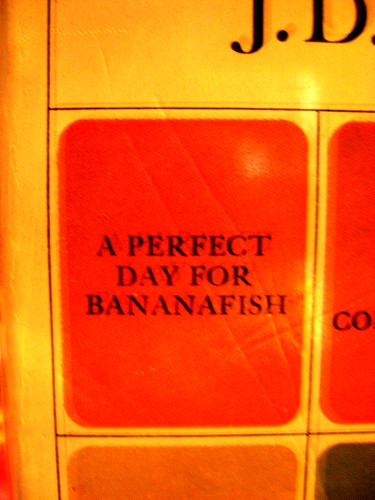
Great Short Story: J.D. Salinger's "A Perfect Day for Bananafish" II

The First of Salinger's Nine Stories
 Continued from J.D. Salinger's "A Perfect Day for Bananafish" Part I


THERE IS NO MAGIC IN ART, so said Picasso. Instead the great painter claimed that art is just a pile of tricks, one piled on top of the other. The more tricks, the better the art; the better the art, the more there seems to be some sort of magic in it. Whether you believe in magic or not, one of Salinger's greatest tricks was his blending of the literary with the pulpy.

Jerome David (Jerry to his friends) had always set his sights on the illustrious New Yorker. But early on he couldn't get published there and had to settle for "lesser" publications known as the Pulps, magazines like Story magazine and The Saturday Evening Post. Among these pages there was no time or interest in high-brow, pretentious investigations into human blah blah blah. Stories had to be fast, had to have twist endings and had to be real page-turners. The benefit of this early education was that as Salinger's stories matured (ie. as The New Yorker started to accept his work) and he produced master works like "A Perfect Day for Bananafish," so rich in depth of character and insight, they retained the fun, suspenseful edge the pulps had required of him.

In this way "Bananafish" is like a perfect movie. Fun enough to want to watch Saturday night. Deep enough to stay with you well beyond Sunday brunch.


THE STORY THAT AFFECTED ALL THAT CAME AFTER IT
If you've only read The Catcher in the Rye you might not know that all but two of the stories Salinger published subsequent to his only novel (he went on publishing a good fifteen years after Catcher, albeit at a pace that even Stanley Kubrick could lap), are about the Glass family. This obsessive and remarkably unique literary investigation into a small number of related imagined characters that spanned some 18 years of one writer's life all started with "A Perfect Day for Bananafish," which centres around a character named Seymour Glass, the oldest sibling in the Glass family, older brother to Franny, Zooey and Buddy, the narrator of Raise High the Roof Beam Carpenters.

THE STORY
It'll sound droll, if not downright dull to summarize the story, but it seems necessary to mention that "Bananafish" is plot-wise primarily just a pair of conversations. The first is a phone call between a daughter in a hotel room and her mother back home. The second conversation, between a man and a little girl, happens on and near the hotel's beach. Sounds innocent enough when crammed discursively into a pat little summary like this, a pat little summary, I'll add, that's been careful not to give anything away.

To not give anything away but to hint at it, I thought I'd give you a taste of character in a story written by the creator of Holden Caufield, who of the 100 best characters in American fiction, according to Book Magazine, ranked second after Jay Gatsby [sic].


THE PHONE CALL WITH MOTHER
In the opening of "Bananafish," Muriel Glass, on her honeymoon with Seymour in Florida, is alone in her hotel room. Seymour is at the beach. Waiting at the story's beginning to put a call through (1948, remember) to her mother, Muriel "uses" the time. 

She read an article in a women's pocket-size magazine, called "Sex if Fun-or Hell." She washed her comb and brush. She took the spot out of the skirt of her beige blouse. She tweezed out two freshly surfaced hairs in her mole... She was a girl who for a ringing phon dropped exactly nothing... With her little lacquer brush, while the phone was ringing, she went over the nail of her little finger, accentuating the line of the moon.

When finally the call does come through, Muriel's mother takes quick control of the conversation. Her first three lines on the phone to her daughter are:
1. "Muriel? Is that you?"
(Muriel says it is and asks how her mother is.)
2. "I've been worried to death about you. Why haven't you phoned? Are you all right?"
(Muriel says, "I tried to get you last night and the night before...")
3. Are you all right, Muriel?"
(Muriel keeps moving the phone away from her ear. She says, "I'm fine. I'm hot. This is the hottest day they've had in Florida...")

AT THE BEACH WITH A MAN AND A LITTLE GIRL
The second half of the story starts off on the hotel's beachfront property. A little girl, Sybil Carpenter is bored, being forced to listen to a boring adult conversation between her mother and her mother's friend.

"See more glass," said Sybil Carpenter, who was staying at the hotel with her mother. "Did you see more glass?"
"Pussycat, stop saying that. It's driving Mommy absolutely crazy. Hold still, please."  

Mrs. Carpenter was putting sun-tan oil on the Sybil's shoulders, spreading it down over the delicate, wing-like blades of her back. Sybil was sitting insecurely on a huge, inflated beach ball, facing the ocean. She was wearing a canary-yellow two-piece bathing suit, one piece of which she would not actually be needing for another nine or ten years.

With her mother's permission, Sybil sets off and walks over a quarter of a mile to find Seymour Glass, whose lying on the sand.

"Where's the lady?" Sybil said.  
"The lady?" the young man brushed some sand out of his thin hair. "That's hard to say, Sybil. She may be in any one of a thousand places. At the hairdresser's. Having her hair dyed mink. Or making dolls for poor children, in her room ... Ask me something else, Sybil," he said. "That's a fine bathing suit you have on. If there's one thing I like, it's a blue bathing suit."
Sybil stared at him, then looked down at her protruding stomach. "This is a
yellow," she said. "This is a yellow."

The possibly mentally unstable young man, recently back from the war, goes on to take Sybil out into the sea for a swim.

What happens after that I dare not say. Just read it.

[Salinger's The Laughing Man: click it for the next of the Nine Stories I love.]

Sunday, May 23, 2010

This Week's "Music to Read By" Soundtrack

The first two songs in my updated playlist [see left panel; press play] are from movies. I thought they deserved a few words mention.

The first is Yo Yo Ma doing a version of "Gabriel's Oboe" from the film The Mission (1986).  The movie, starring Roberto DeNiro and Jeremy Irons, may have won the Palme d'Or and the Oscar for best cinematography, but for many it's Ennio Morricone's soundtrack that is the most memorable aspect of the film. Morricone, who has composed and arranged film scores for films as varied as The Untouchables and Cinema Paradiso, became famous scoring spaghetti westerns (40 of them) including The Good, The Bad and The Ugly. (If Clint Eastwood starred in it and you can whistle the music from it, Ennio Morricone composed it.)

The second song, "Yumeji's Theme" by Shigeru Umebayashi, was made famous in Hong Kong director Wong Kar Wai's film, In the Mood For Love (2000). If I were taking movies to my desert island, for the photography and music alone, In the Mood for Love would come with.

Friday, May 21, 2010

Great Short Story: J.D. Salinger's "A Perfect Day for Bananafish" I

The First of Salinger's Nine Stories 
[Introduced Here]

When perhaps the world's most famously reclusive writer died my father didn't write J.D. Salinger a letter. The Catcher in the Rye was not the reason my dad chose his profession (academia). And, as far as I know he has never read Raise High the Roof Beam, Carpenters and Seymour: An Introduction, never mind reading eight of the Nine Stories I'm here to speak about. But when you mention Salinger's name, my father always brings up "A Perfect Day for Bananafish" (1948), the story that opens Nine Stories.

My dad (Aba), it turns out, has good taste. This is probably the most famous short story ever published in The New Yorker

When Aba was just David and a teenager growing up in South Africa, a counselor at his (Habonim) sleepover camp read the famous story aloud to him and his fellow campers. I imagine the boys in their bunks on a humid night, clutched to the end of their beds' rusted metal frames, waiting to find out what happens next. Now a story, half of which is a phone conversation between a recently married bride and her mother wouldn't exactly seem a teenage boy's cup of tea. But then the best of anything is always so good as to break down the boundaries between man/woman, adult/child (think french fries, think a Van Gogh painting).

Inspired by this counselor's fireside idea, I read "A Perfect Day for Bananafish" aloud to a couple sets of friends when I was still living in Japan. (Said friends were not in bunk beds at the time). For perspective, in case you were picturing me regularly reading stories to strangers at my local Starbucks, the only other time I read aloud to people that aren't my wife, is when they are kids or when, more than a decade ago, I worked at a camp with autistic children (read them Charlie and the Chocolate Factory).

I've heard Salinger described as having a ventriloquist's ability - the way that he can inhabit the voice and nature of his characters. In "A Perfect Day for Bananafish" this includes: a little girl, a potentially mentally unstable man, a rather overbearing mother, and her rather superficial daughter. Each voice sounds right, sounds real. For the actor in me you can see why it would be a lot of fun to read aloud.

For the reader in you, Part II will, I hope, entice when you hear the sounds of those characters voices, and get a hint of the drive and depth of one hell of a brilliant yarn.

Click Salinger's "A Perfect Day for Bananafish Part II to continue reading.

Wednesday, May 19, 2010

Coming July - From the Director of "The Dark Knight"


Um ... whoa.
See you in the theatre.

Monday, May 17, 2010

Raise High the Short Story Form, Salinger and Nine Stories: An Introduction

Many have already proclaimed that with series' like "The Sopranos" and "Mad Men," we're in a golden age of TV (again). TV today is arguably churning out better quality stuff than what's being put up on the big screen. And considering how much the middle budget picture (think "A Few Good Men," think "American Beauty") - what has consistently been Oscar's bread and butter - is being squeezed out by studios investing most all their money into one or maybe two "tent-pole" movies a year (think "Avatar") this leaves only enough room for small budget fall and spring crap (think horror, think Jennifer Aniston vehicles).

Sick with cold last weekend and watching way too many "Mad Men" episodes it dawned on me that these high quality television series' are the closest the screen gets to a novel, in that they have the scope, and time, to delve deep into multiple characters and subplot. This being the case, I realized, conversely, that a feature film is actually closer in form to the short story, as movies can only deal with so many characters and they only have a couple hours in which to tell their tale.

For proof, here, some examples of movies based on short stories:
Minority Report
Brokeback Mountain
Memento
Rear Window
2001: A Space Odyssey
Rashomon
Psycho


I say all this to defend an art form that struggles for readership (assuming you're last name isn't Lahiri). I say it also for those of you not big on the form, who might have overlooked what can and should be packed into a 17 or 26 page story. I say it because as you may know J.D. Salinger was my first favourite writer (I sound like a kid talking about his firstest bestest ever friend) and yet I've only really written about The Catcher in the Rye. This is akin to being a die hard Beethoven fan and only every discussing the 9th, ignoring all the rest (including the 5th). For many Salinger fans, myself quite possibly included, it is, in fact, the short story form where Salinger was best. He certainly deserves to be called a master of the form. This is how he learned his craft; it's how he achieved his early fame; it's where Holden Caufield was first conceived of as a character. It's also where he wrote some of my all-time favourite stories.

I'd like, over the next few weeks, when not posting about movies and other books, to introduce you to/remind you of Salinger's Nine Stories. A few, like "A Perfect Day for Bananafish" are so famous and craft-perfect, as to deserve their own posts. Others I'll skip right over. This won't dreidel (to use one my father's favourite verbs) on forever. Don't you worry, sunshine. You might even like it.

For the first and most famous one click "A Perfect Day for Bananafish"

Thursday, May 13, 2010

What to Rent: Steven Soderbergh's "Out of Sight" (1998)


The Crapfest That Is "Ocean's 11," 12, 13

I remember a film critic, I think it was, speaking to how much director Steven Soderbergh's (no relation to that other Steven) "Ocean's" movies were a joke to the players involved. This not to say that the actors and a director of this calibre were just mucking about. There's much too much money involved. And while Brad Pitt, George Clooney and the entourage of lawyers and Ari Gold style agents behind them obviously understand how much big budget success is critical to keeping their movie stars bright, you just know the whole time they were filming that Clooney was itching to do more challenging, more political movies, that Brad Pitt already knew he was simply better suited to playing quirky characters with extreme personalities and that Soderbergh was looking down his nose at the entire project waiting to do the 'smarter' movies he made in between "Ocean" outings.

The problem for me is, I don't like much of Soderbergh's 'smarter' fare either (with the notable exception of "Traffic"). "Solaris," anyone? God help us. I'd rather watch the real thing (ie. "2001") or else watch paint dry. I should admit I've not seen "The Informant" or "Che." Nor am I convinced I want to.

"Out of Sight" though. Damn. Granted, you've gotta go back more than 10 years to see Soderbergh using his definite talents to not poo-poo but instead raise up a fun and funny pulpy story to make it stylish and sexy and fucking fantastic. If you haven't seen it, there is much to love, including great jail scenes, fun heist moments and just amazing repartee between so many of the characters thanks to the movie being based on an Elmore Leonard novel ("Get Shorty," "Jackie Brown"). This is a hell of a quotable movie.

George Clooney plays Jack Foley. He is a small-time bank robber. He's smart, slick, suave but not actually that good at his job. Jennifer Lopez plays Karen Sisco. She's an FBI agent. Very good at her job. They first meet in the trunk of a car. He's broken out of jail, taken her hostage. (Run with it.) She spends much of the rest of the movie chasing him. The scene, that to my mind, makes the movie - the reason for this post - is when they finally meet again. But more on that in a moment.


First - quickly - The Second Bananas

It's fun to return to a movie and realize how well it was cast, how many of the side characters are now names you know or faces you recognize.

"Out of Sight" features:
-Don Cheadle ("Traffic," the "Ocean's" movies, celebrity poker television);
-Catherine Keener ("Being John Malkovich," "Where The Wild Things Are");
-Dennis Farina ("Get Shorty"), a legend; and
-Steve Zahn* [see comments] ("Reality Bites"), the most scene-stealing performer of the bunch.

But none of it would be nearly so memorable, nor would I keep revisiting "Out of Sight" if not for One Great Scene.

Karen Sisco: You kept touching me, feeling my thigh.
Jack Foley: But in a nice way.


Foley has now left L.A for Detroit. It has to do with stealing diamonds. Karen Sisco has followed him there. She is in a Detroit hotel at night, the snow falling in the background.

A zippo. Her hand on a glass of bourbon. His hand wrapping round hers. The dialogue, fast, fun, sharp, playful, honest, dangerous. Them watching each other get undressed. You'll see. I'm gonna show you the clip so you can get a feel for the great stamp of style Soderbergh's put on this whole fine flick (give it a few). To set it up:

The people who put things on youtube have kindly posted the scene but unfortunately (callously) not included the first 3 minutes. So please, before you watch, if you've never seen it before, for context,

Finally,
know that Karen (J.Lo) is sitting alone at a table at this hotel bar. Three men, ad guys are up at the bar. The first, Phillip, comes up, hits on Karen. She says she doesn't want to be rude, "Phillip" but manages to stave him off. As he walks back to the bar, his bespectacled, pale-faced friend, Andy, is already coming towards Karen's table, giving Phillip a little finger tap as he passes his rejected friend by. Andy, even more over-confident than his buddy doesn't even wait to be invited. He sits at Karen's table, tells her he knows why she's depressed. He tells her she's a sales rep having a hard time because she's a girl. Andy goes on about himself, that they're "ad guys, from the Apple" and he tells her about some "Bandito, Mexi-Hispanic" ad campaign they're working on (the great ironic pleasure of watching whitey tell of his blatantly stereotype-foolish Latino ad campaign to this Latino woman) and finally Karen cuts in. She says, "Really, Andy, who gives a shit?"

Stunned he responds saying something to express his incredulity.

"Beat it, Andy" is what Lopez's character says. Finally she is again alone, as she wanted, unless of course George Clooney as Jack Foley were to walk in the bar. Which he does:


Enjoy.

Monday, May 10, 2010

Book Recommendation: Rawi Hage's "Cockroach"

The Dark and Lyrical Immigrant Experience in Montreal

Little need be said about this slim novel except that it was a jarring pleasure to see the sneaky, sly book classified as Canadian.

Lyrical and angry, poetic and sinister, this is not your grandmother's prairie novel. Montreal feels dark. The criminal is so sexual. The sexual so perverse. The vice is nice. This is how I feel inspired by this book; not to impart analysis on the author's political history (war torn Lebanon), because the book so masterfully manages to touch on the political without getting bogged down in it. Which is to say the dream is never ruined. The darkened streets are never lit too bright with some lecture. There are no lectures. There is little light. The beauty is in the darkness, and the flow of the language.

Amen to that.

Friday, May 7, 2010

A Movie Smart and With Heart: The Secret in Their Eyes (El Secreto De Sus Ojos)

It won the Oscar for best foreign film this year.

The Internet Movie Database lists it as a Crime, Drama, Mystery, Romance, Thriller.

This is accurate.

Humor is something else that is abundant throughout, but it's not a comedy.

The romance and the humor offset a dark story based around the solving of a gruesome murder. The darkness balances the yearning of a love story that is tender and true and so rare on a big screen, particularly for how much it has you wanting to see it work, wonder if it will work (I won't tell you). I never thought the phrase 'It'll have you rooting for X' in a movie could be taken sincerely (thought it was reserved for Sandra Bullock vehicles). It can when the main characters have this much humanity.

He's a man of great integrity. I fell in love with her.

Though not a true story, its filled with detail that makes the lives of these people, the place they work, their homes, the bars they hang out in all feel real, but yet its not so real as to be arty (in the incomprehensible or banal senses of the word). Thought made in Argentina, the movie still has that stuff of the mythic that Hollywood is so good at, the stuff that raises a narrative above the everyday, that magic stuff we wanted before we went to sleep as kids (and still want, no?)

"The Secret in Their Eyes" won't be in theatres (for those lucky enough to even have it in theatres close to home) much longer. It may not be a perfect movie, but it's well worth the price of admission.

Thursday, May 6, 2010

Reading


Fiction
Mary Gaitskill's "Bad Behavior"
Tim Winton's "The Turning"
Amelie Nothomb's "Tokyo Fiancee" (re-reading)


Non-Fiction

Jonathan Franzen's "How to Be Alone"
Francine Prose's "Reading Like a Writer"
The back of "Cereal Boxes"

Monday, May 3, 2010

The Best Show on TV: Mad Men

I think about Mad Men a lot. I think about dressing differently because of this show, acting differently. Suavity suddenly seems a more serious priority. I mean, really, I'm second-guessing wearing t-shirts, wondering if I would ever wear a suit (to go write in a cafe). That's how good it is, and I haven't finished the first season.

I'm years behind on this, I know, but how many of us watched the Sopranos, never mind The (British) Office, in real time either? Huh? Huh? So there.

In 37 seconds, the show's opening sequence that so masterfully blends music (the theme music!) and animation, says it all, shows it all, the series's style, it's theme, it's subtle brilliance. As a friend put it, that opening manages to encapsulate just about everything the show is about, and more than anything Mad Men is about appearances, about what we show vs. who we are. Specifically put, this is a show about the style and lifestyle of the advertising men, and the women they screw (metaphorically and otherwise), on Madison Avenue in the early 1960s. The show both venerates and judges hell out of that hard smoking, heavy drinking world and in, turn, we find ourselves looking back with a dizzying flip-flop of reverent nostalgia one minute, for a time when you were allowed to have a vice or two, to the next when we're shocked and horrified at what we see. The frozen food dinners! But seriously, or, at least most pointedly, how abysmally women were treated, both the ones working in the office, and those sequestered off to work in the home.

Mad Men is so good, so smart, that I do believe it will change TV and movies. One small, but not insignificant example of this is how, I predict, it will change the types of women we see on screen thanks to a rather voluptuous, hip swaying character who is probably almost literally twice the woman Kate Moss is. I think we may just see a lot more women with actual bodies (hips, tits, and even, god forbid, a little belly fat) back on screens big and small in the next few years.

It goes without saying that the best show on TV is a true ensemble - the whole cast is excellent - and the writing is whip-smart, especially for scenes within the advertising office where so much of Mad Men takes place (see pilot episode - the scenes about Lucky Strike cigarettes, for example).Like every great story, it all comes down to how much we care and invest in its characters. The characters are interesting because they are complex, because they are flawed, conniving, jealous, angry, repressed, smart, striving; one can be downright sinister (and that's always interesting*).

Because when you've outgrown the Michael Bay hyper editing version of how to SIS-BOOM-BAH! tell a story, and really need to put that electronic device down - to just slow down - it's nice to sit back, sip a scotch on the rocks and see something that's not in any rush to get anywhere.

I'm hooked.

*[Read East of Eden for proof of the vitality a sinister character gives every scene he or she is in.]
Follow mendelsohnjon on Twitter