I went with my sister to see a French movie in an old beat up movie house called the Mt Pleasant on Saturday. The film, "I've Loved You So Long" is not light (of course not, Jon, it's French). There are no dogs. Jennifer Aniston makes no appearance. But I liked the movie a lot. I liked the acting. I liked the lack of showy direction. They say the best directors are the ones you are least aware of. I thought this was pretty true of the movie. Kirstin Scott Thomas was the star and she is, a star. A great performance.
Quoting Cornell West, a modern day philosopher (turns out they still exist), my wife told me last night of this idea that a great book or movie, that these, though they are solitary and not social, are actually what can make us more alive. That we are More Alive reading (or watching) good art. I loved this. Not only, of course, because it suits me, but because in a time when we usually only acknowledge aliveness in the gym bunny, the guy or gal puffing away on the tread mill, I like to think there is a whole other dimension to being alive. And that exercise is only part. As Ai said, all the people you are meeting and getting to know, and so intimately, in a good book or a movie, the full-on experience of this.
I find that movies like "I've Loved You So Long" ("Il Y A Longtemps Que Je T'aime"), though dealing with difficult themes, make me feel more alive. The intensity of life. I dig that, you know? Also, movies where men can discuss literature at dinner parties, and women in smoky cafes smoke Pall Mall cigarettes, drink strong coffee and are smart as hell. And beautiful, but in a quiet way.
Wednesday, January 28, 2009


Wednesday, January 21, 2009
Retrospective: Piece on Japan previously published in the Facts & Arguments section of the "The Globe and Mail"

On Travelling, Traffic, Tokyo and Starbucks
When first asked why the chicken crossed the road, did you picture it crossing in traffic? Was it walking with a friend? In a crowd? Having grown up on the spacious side of the world – namely Canada – my chicken always crossed solo. No cars either. It probably comes down to a lack of imagination. Still, I wonder what Tokyoites envision when you ask them the old joke.
My first full day in Tokyo I’d already walked a fair bit before taking a packed train to Shibuya, the busiest section of the city. Picture the kind of masses that only form in Canada’s biggest cities those first minutes after a sold-out game or after the U2-sized concert has let out: that was the area in front of Shibuya station, a concrete island seemingly designed for loitering and fake watch selling. With no watches to sell or places to sit, I stood amongst the crowd. As anyone who’s ever visited a foreign downtown knows, you spend most of your time walking or standing. Sitting is a privilege you usually have to pay for, which brings us to Starbucks (pronounced Sta-buck-sue in Japan), whose logo was first to catch my eye as I exited the station, followed by a McDonalds and then the big screen TVs on separate but tightly packed-in buildings directly across the street. Not to mention the endless signage for luxury cars and affordable cars and of course electronics.
I arrive somewhere new and instinctively move toward the familiar. I’m not the only one; this the genius of the franchise industry. Thus my sordid affair with Starbucks. I'm not a traveller in the true sense of the word. I'm a fake. Really I just go from Starbucks to Starbucks and occasionally (I admit) to McDonalds (macu-dona-ru-do). But for coffee and comfort at the busiest Starbucks in the world (so the barista told me) I would first need to cross Shibuya intersection.
Composed of five merging streets and four white-striped pedestrian crossings, it too holds a record, as the busiest intersection in the world with more than two million people passing over it each day.
As I approached, the lights had just turned red and wouldn’t be turning green for some time. Traffic lights in Japan are, apparently, as patient as its people. Hundreds of seconds would pass before the lights would change. People streaming out the station added to the population growing around me. Across the street two narrow avenues, lined on either side with short buildings, converged in a V at the Starbucks building. There our opposition gathered and expanded waiting for the light so they could cross to get to the train station behind me. And this was only one of the four pedestrian crossings. The others filled equally frantically.
When I was eight, about the time I was learning variations of the chicken joke, I was also big on Red Rover. You remember the game, where you split into two teams, each forming a horizontal line. You then spread out, but not too far so you can hold hands and face the other team’s row. Team A calls out an individual from team B who must then ran fast as they can across the field to try and break a weak link in team A’s handheld chain. They play this game in Shibuya too only instead of facing one long horizontal line you are facing twenty or forty horizontal lines of people packed in so tight there’s no need for handholding.
In this game, instead of hands you break through people. And instead of one person being called to cross over, all however many hundreds of you are called over at the same time as you call over the hundreds of them.
Red rover, red rover.
Like their New Yorker cousins, Tokyoites march poker-faced, always with purpose. When that light turned green the people at my sides effortlessly parted the hectic crowds charging toward them. I faired less well. The light changed, I took a deep breath. With a stampede behind me I stepped, like a wobbly toddler, out toward the oncoming herd. Instead of bulldozing a path, I tried to excuse-me-pardon-me my way out of everyone else’s. Judging by the looks on their faces, I was screwing the whole game up. A classic traveller error: to play too much defense and not enough offence – the overly polite instinct in the foreigner.
I won’t lie. It was a harrowing experience but I finally made it across. Got my latte and a second floor counter seat too. It faced a large bay window, the Shibuya intersection below. At one point I even tried counting heads. I gave up quickly and had to look away from the anthill commotion. Just looking was exhausting. Travel’s like that. It’s tiring. In fact, leisure is a Greek word meaning work. Why then do we travel? Why did this Canadian cross the ocean? To get to another Starbucks, of course.
Friday, January 16, 2009
Ps and Qs
A friend of mine is in Montreal, back in the day (the university day). He's at an after hours club, the kind without alcohol where drugs like ecstasy (aka MDMA, which until about 1985 was legal in the U.S. and prescribed by psychiatrists for couples who needed to put a little "love" back in their relationship) are mucho abundantero. So my friend is walking down a narrow passage of the nightclub and this big guy passes by and as he does, big guy shoulder-bumps my friend, and not softly either. But as my friend is ready to get all huffy-angry and ruin-his-night upset, big guy turns round and says to my friend, literally offering out his hand, "Sorry, man," instantly diffusing any negative energy momentarily created.
The point of the story is not to promote lovey-dovey inspiring amphetamines over more aggressive intoxicants like alcohol, but rather to suggest that a little sorry goes a long way, and am I just getting very crotchety old man or have please and thank you started to disappear from urban society?
The point of the story is not to promote lovey-dovey inspiring amphetamines over more aggressive intoxicants like alcohol, but rather to suggest that a little sorry goes a long way, and am I just getting very crotchety old man or have please and thank you started to disappear from urban society?
Friday, January 9, 2009
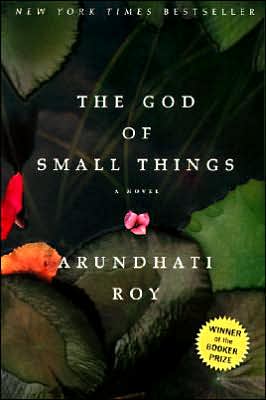
Desert Island Novel to Read and Read and Read Again # 3: Arundhati Roy's "The God of Small Things"
[Click The Catcher in the Rye for Desert Island Book to read and read and read again #2]
May in Ayemenem is a hot, brooding month. The days are long and humid. The river shrinks and black crows gorge on bright mangoes in still, dustgreen trees. Red bananas ripen. Jackfruits burst. Dissolute bluebottles hum vacuously in the fruity air. Then they stun themselves against clear windowpanes and die, fatly baffled in the sun.
This is the opening of Arundhati Roy's The God of Small Things, a novel I didn't like the first few times I tried reading it. It couldn't approach my heart or soul. I thought it was boring, and kind of bad poetry. The slog that was those first pages, those first few tries.
A question: must you finish a book even if you aren't enjoying it? Some take the marathon runners view. I must finish it, I must finish it. I will not stop, I won't, I won't. Others say screw it (or phrase it more eloquently). Life is too short. There's too much out there I want to read. And put the book down.
There are plenty books I've not finished. Many I have barely started. (This coming from a guy who re-reads his favourite authors ad nauseum and only has about five fingers worth of them writers.) And yet if not for perseverance I'd never have finished Don Quixote, which I did not enjoy while reading but that has certainly stayed with me the way most books never do. Ditto for Joyce's short story collection The Dubliners which was pure dictionary-sending-me-to slog when read, on assignment, for uni, but that I find myself now going back to and admiring the hell out of. Dare I say, loving.
Like its opening, the first pages of The God of Small Things are dense poetic description. The kind that often frighten off those of us interested in coherent plot. I worried this story would be all abstract prettiness with no purpose or concrete narrative line. But then I must have listened to Miles Davis' Kind of Blue [see soundtrack for samples] ten times before it stopped sounding like elevator music and became what to date is my all-time favourite, or at least most listened to, album. In short, I probably give up too easy, too often (10 pages of Ulysses), but sometimes it really is worth the effort.
Roy's only novel to date (it's been over ten years; the writer now works on global political issues) is made like a puzzle. Roy, it seems pertinent to note, was trained as an architect, and the careful design of the novel is such that you need the final puzzle pieces (late pages of the book) to see the big picture, to "get" the story. This at first can be frustrating. But if you make it through the dense opening pages - barely aware how effectively she has pulled you into the humid air of a South Indian town, through swampy smells and mango trees and insects you've barely heard of - you realize that like the director of a good movie, she is taking you on a narrative journey that is far more coherent, with each passing page, than you might at first expect.
The book makes it to my island because the clever design is not just circus tricks. In The God of Small Things Roy is dealing with those subjects we usually cannot talk about. This for me is the purpose of good fiction. The exact opposite of polite conversation. The novel is anything but polite, or easy. It is difficult. The issues are difficult, and I'm being vague in the extreme to not ruin anything.
There are so many storytellers (writers and directors both) who present bleak narratives. Stories that don't hide away and pretend pain isn't real, that hardships aren't universal. But there is a sharp division between those artists that manage to put a little humanity in their stories (and by humanity I do not necessarily mean fairytale endings) and those, like Dancer in the Dark director Lars Von Trier, who seem only to want to lift a reader up to then God-like manipulatively drop them down. There are puppet-master storytellers who are sadistic like that. Arundhati Roy is far, far from.
Her story is undoubtedly painful. But its pain - the whole story - has a beauty - which the single paragraph from the novel I have quoted speaks to - a beauty of hidden realities that bruise our histories but also, hopefully, shine a light all the brighter on the reasons why we are alive.
[For Desert Island Book to read and read and read again #4 click John Steinbeck's East of Eden]
May in Ayemenem is a hot, brooding month. The days are long and humid. The river shrinks and black crows gorge on bright mangoes in still, dustgreen trees. Red bananas ripen. Jackfruits burst. Dissolute bluebottles hum vacuously in the fruity air. Then they stun themselves against clear windowpanes and die, fatly baffled in the sun.
This is the opening of Arundhati Roy's The God of Small Things, a novel I didn't like the first few times I tried reading it. It couldn't approach my heart or soul. I thought it was boring, and kind of bad poetry. The slog that was those first pages, those first few tries.
A question: must you finish a book even if you aren't enjoying it? Some take the marathon runners view. I must finish it, I must finish it. I will not stop, I won't, I won't. Others say screw it (or phrase it more eloquently). Life is too short. There's too much out there I want to read. And put the book down.
There are plenty books I've not finished. Many I have barely started. (This coming from a guy who re-reads his favourite authors ad nauseum and only has about five fingers worth of them writers.) And yet if not for perseverance I'd never have finished Don Quixote, which I did not enjoy while reading but that has certainly stayed with me the way most books never do. Ditto for Joyce's short story collection The Dubliners which was pure dictionary-sending-me-to slog when read, on assignment, for uni, but that I find myself now going back to and admiring the hell out of. Dare I say, loving.
Like its opening, the first pages of The God of Small Things are dense poetic description. The kind that often frighten off those of us interested in coherent plot. I worried this story would be all abstract prettiness with no purpose or concrete narrative line. But then I must have listened to Miles Davis' Kind of Blue [see soundtrack for samples] ten times before it stopped sounding like elevator music and became what to date is my all-time favourite, or at least most listened to, album. In short, I probably give up too easy, too often (10 pages of Ulysses), but sometimes it really is worth the effort.
Roy's only novel to date (it's been over ten years; the writer now works on global political issues) is made like a puzzle. Roy, it seems pertinent to note, was trained as an architect, and the careful design of the novel is such that you need the final puzzle pieces (late pages of the book) to see the big picture, to "get" the story. This at first can be frustrating. But if you make it through the dense opening pages - barely aware how effectively she has pulled you into the humid air of a South Indian town, through swampy smells and mango trees and insects you've barely heard of - you realize that like the director of a good movie, she is taking you on a narrative journey that is far more coherent, with each passing page, than you might at first expect.
The book makes it to my island because the clever design is not just circus tricks. In The God of Small Things Roy is dealing with those subjects we usually cannot talk about. This for me is the purpose of good fiction. The exact opposite of polite conversation. The novel is anything but polite, or easy. It is difficult. The issues are difficult, and I'm being vague in the extreme to not ruin anything.
There are so many storytellers (writers and directors both) who present bleak narratives. Stories that don't hide away and pretend pain isn't real, that hardships aren't universal. But there is a sharp division between those artists that manage to put a little humanity in their stories (and by humanity I do not necessarily mean fairytale endings) and those, like Dancer in the Dark director Lars Von Trier, who seem only to want to lift a reader up to then God-like manipulatively drop them down. There are puppet-master storytellers who are sadistic like that. Arundhati Roy is far, far from.
Her story is undoubtedly painful. But its pain - the whole story - has a beauty - which the single paragraph from the novel I have quoted speaks to - a beauty of hidden realities that bruise our histories but also, hopefully, shine a light all the brighter on the reasons why we are alive.
[For Desert Island Book to read and read and read again #4 click John Steinbeck's East of Eden]
Tuesday, January 6, 2009
When the Booing Stopped
Remember at the cinema when there were no commercials before the previews?
Then when they put the commercials in folks booed the hell out of them.
When the booing stopped at least people made a point of talking through them.
Now. Now everyone watches cell phone ads and car commercials in muted daze, mouths slightly open, slow lines of drool dribbling down their chins.
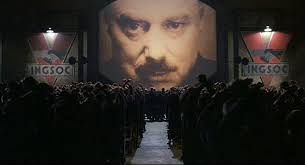
As a prof of mine one said, commenting on Orwell's "1984,"
'Big brother doesn't need to watch us - we're watching him.'
Friday, January 2, 2009
The First Stanza of the First Country Song Jon Never did Write
Slow down long enough and you begin to ask how, and why
Slow down too long and you begin to cry
Slow down too long and you begin to cry
Thursday, January 1, 2009
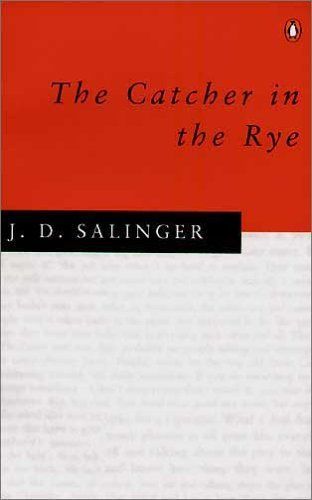
The Greatest Novels Heal Your Soul Even As They Break Your Heart # 2: The Catcher in the Rye - Part II
[Continued from Catcher in the Rye Part I]
For Best Novel Ever #1 click Haruki Murakami's "Norwegian Wood."


HIS ART
What is so artful about "Catcher" is that it is anything but a journal. Are there pieces of Salinger's childhood in the book? Of course there are. But is Holden Caufield Jerome David Salinger? No! Not remotely. Because only by creating/inventing a character so true can he really resonate with an audience so deeply. We still talk centuries later about the Hamlets, the Sancho Panzas and the Huck Finns because they resonate. Even if you think "A Heartbreaking Work of Staggering Genius" is a great book (and I do), no one talks about the main character in Dave Eggers story. And that book is not even ten years old. But Holden Caufield like Ebenezer Scrooge is a name that more than half a century later people remember.
THE VOICE
How do you portray a teenager in fiction? Has anyone ever done it better than Salinger? Only Mark Twain's creation could compete (and it should be noted that "Huckleberry Finn" is alluded to in "Catcher" because Twain's book was such an obvious influence - there is, after all, nothing new under the sun; nobody reinvents the wheel ... add cliched truism at will). Here's Holden, sitting on one of the washbasins in the bathroom describing Stradlater, his roomate at Pencey Prep:
Stradlater kept whistling 'Song of India' while he shaved. He had one of those very piercing whistles that was practically never in tune, and he always picked out some song that's hard to whistle even if you're a good whistler, like 'Song of India' ... The reason he fixed himself up to look good was because he was madly in love with himself. He thought he was the handsomest guy in the Western Hemisphere. He was pretty handsome, to - I'll admit it...
And that's the other thing, like with Murakami's "Norwegian Wood" (Murakami who recently did a new translation of 'Catcher into Japanese, that's how big a fan he is), "Catcher," which is filled with loneliness and the challenges of growing up, is funny. Holden's got wit, boy, he really does.
Take most people, they're crazy about cars. They worry if they get a little scratch on them, and they're always talking about how many miles they get to a gallon, and if they get a brand-new car already they start thinking about trading it in for one that's even newer. I don't even like old cars. I mean they don't even interest me. I'd rather have a goddam horse. A horse is at least human, for God's sake.
THE LOVE
An English professor of mine once attacked me for loving "The Catcher in the Rye," saying it was just a silly book about an upper-middle class kid whining about his problems. This professor, it should be noted, had us reading books about black lesbians suffering in America. Suffice it to say I am no longer insulted by his opinion because I don't think great art has to be about Big Issues. Because it seems to me that the capital A academics reading that most opaque kind of Big Issue literature for their post-doctoral papers are the ones who go read Harry Potter when on that beach in Costa Rica.
Are we really only supposed to swing in literature from that Harry Potter lite extreme, to the Holocaust, slavery unhappy other? Is there not a place in literature for books with characters that go through the hardships we go through here and now? A book that manages to entertain and edify at the same time? I think there is. I think it's the hardest kind of stuff to write, to write well. But it's out there. And it's the stuff I love.
I can't listen to Pink Floyd's 'Comfortably Numb' anymore, but some 17 years since that first read and be it on a beach or in a lecture hall, "The Catcher in the Rye" still wows me. That's why it makes it to my island.
[For Best Novel Ever #3 click Arundathi Roy's "The God of Small Things."]
For Best Novel Ever #1 click Haruki Murakami's "Norwegian Wood."

HIS ART
What is so artful about "Catcher" is that it is anything but a journal. Are there pieces of Salinger's childhood in the book? Of course there are. But is Holden Caufield Jerome David Salinger? No! Not remotely. Because only by creating/inventing a character so true can he really resonate with an audience so deeply. We still talk centuries later about the Hamlets, the Sancho Panzas and the Huck Finns because they resonate. Even if you think "A Heartbreaking Work of Staggering Genius" is a great book (and I do), no one talks about the main character in Dave Eggers story. And that book is not even ten years old. But Holden Caufield like Ebenezer Scrooge is a name that more than half a century later people remember.
THE VOICE
How do you portray a teenager in fiction? Has anyone ever done it better than Salinger? Only Mark Twain's creation could compete (and it should be noted that "Huckleberry Finn" is alluded to in "Catcher" because Twain's book was such an obvious influence - there is, after all, nothing new under the sun; nobody reinvents the wheel ... add cliched truism at will). Here's Holden, sitting on one of the washbasins in the bathroom describing Stradlater, his roomate at Pencey Prep:
Stradlater kept whistling 'Song of India' while he shaved. He had one of those very piercing whistles that was practically never in tune, and he always picked out some song that's hard to whistle even if you're a good whistler, like 'Song of India' ... The reason he fixed himself up to look good was because he was madly in love with himself. He thought he was the handsomest guy in the Western Hemisphere. He was pretty handsome, to - I'll admit it...
And that's the other thing, like with Murakami's "Norwegian Wood" (Murakami who recently did a new translation of 'Catcher into Japanese, that's how big a fan he is), "Catcher," which is filled with loneliness and the challenges of growing up, is funny. Holden's got wit, boy, he really does.
Take most people, they're crazy about cars. They worry if they get a little scratch on them, and they're always talking about how many miles they get to a gallon, and if they get a brand-new car already they start thinking about trading it in for one that's even newer. I don't even like old cars. I mean they don't even interest me. I'd rather have a goddam horse. A horse is at least human, for God's sake.
THE LOVE
An English professor of mine once attacked me for loving "The Catcher in the Rye," saying it was just a silly book about an upper-middle class kid whining about his problems. This professor, it should be noted, had us reading books about black lesbians suffering in America. Suffice it to say I am no longer insulted by his opinion because I don't think great art has to be about Big Issues. Because it seems to me that the capital A academics reading that most opaque kind of Big Issue literature for their post-doctoral papers are the ones who go read Harry Potter when on that beach in Costa Rica.
Are we really only supposed to swing in literature from that Harry Potter lite extreme, to the Holocaust, slavery unhappy other? Is there not a place in literature for books with characters that go through the hardships we go through here and now? A book that manages to entertain and edify at the same time? I think there is. I think it's the hardest kind of stuff to write, to write well. But it's out there. And it's the stuff I love.
I can't listen to Pink Floyd's 'Comfortably Numb' anymore, but some 17 years since that first read and be it on a beach or in a lecture hall, "The Catcher in the Rye" still wows me. That's why it makes it to my island.
[For Best Novel Ever #3 click Arundathi Roy's "The God of Small Things."]
Subscribe to:
Posts (Atom)
